In short
Blocked practice, where you repeat one type of problem until it feels mastered before moving on, produces fast improvement during the session but weak long-term retention and poor transfer. Interleaved practice, where related problem types are mixed together, feels slower and more error-prone at the time but produces substantially better performance on delayed tests, especially when the task requires telling similar things apart. The advantage comes from forced discrimination between categories, not from the difficulty alone.
Open almost any textbook chapter and the practice problems at the end are blocked: a page of subtraction problems following a section on subtraction, a page of ratio problems following a section on ratios. This structure feels efficient and produces visibly fast improvement within the session. It is also, for a wide range of skills, the less effective way to practise — a finding robust enough that it now has its own line of research separate from spacing and retrieval.
Defining the two conditions
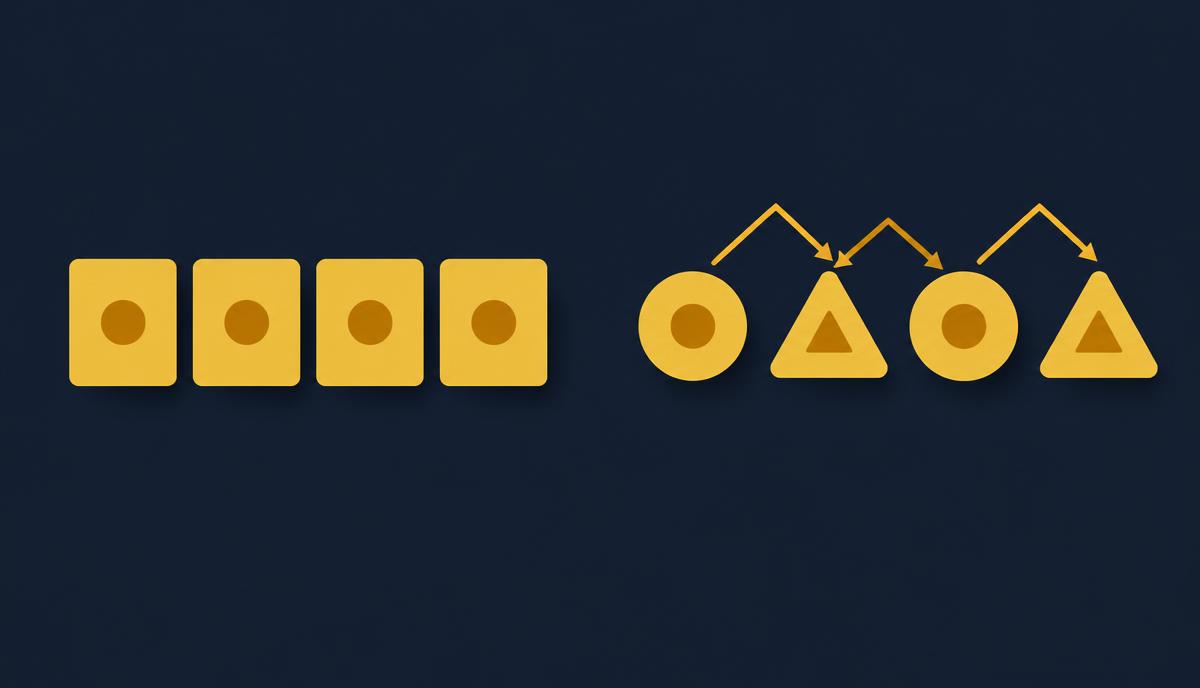
Blocked practice groups repetitions of the same problem type together: AAAA BBBB CCCC. Interleaved practice mixes different but related problem types within the same session: ABCA CBAC BCAB. The comparison only matters when the categories are related enough to be confusable — interleaving typing practice with cooking practice tells you nothing useful, because there is no discrimination to learn between them.
The performance-versus-learning gap
The central finding, demonstrated repeatedly since Shea and Morris's early motor-skill studies and extended into mathematics by Rohrer and Taylor, is a dissociation between performance during practice and learning measured afterwards. Blocked practice produces better performance while it is happening, because you know which method to apply before you even read the problem. Interleaved practice produces worse performance while it is happening, and better performance on a test given days or weeks later.
Practice-session accuracy vs. one-week delayed test accuracy
% correct
Illustrative pattern based on the general shape reported in interleaving studies on categorisation and mathematics problems (e.g. Rohrer & Taylor); values vary across specific studies and tasks.
This is why interleaving is easy to abandon in practice: it looks like it is failing exactly when it is working, and blocked practice looks like it is succeeding exactly when the gains are about to evaporate. Anyone judging technique by how a single session feels will consistently choose the worse method.
Why mixing works: the discrimination account
The leading explanation is not simply that interleaving is harder in some generic sense. It is that blocked practice never requires you to decide which method or category applies — the answer is given by the position on the page. Interleaved practice forces two separate skills on every attempt: recognising which category a problem belongs to, and then executing the right method for that category. Many real failures, particularly in mathematics, are not failures to apply a method once selected but failures to select the right method in the first place, and blocked practice never trains that selection step at all.
| Structure | Trains method execution | Trains method selection | Feels difficult during practice |
|---|---|---|---|
| Blocked | Yes | No — the category is already known | No |
| Interleaved | Yes | Yes | Yes |
Where the evidence is strongest and weakest
The effect is best established for tasks that require classifying a problem before solving it: distinguishing which formula, rule, or technique applies among genuinely similar options. This covers a large share of school mathematics, statistics, some medical diagnosis training, and categorisation tasks such as identifying an artist's style or a bird species. It is weaker or unproven for tasks with no meaningful classification step, such as memorising an unordered vocabulary list, where interleaving mostly overlaps with the separate benefits of spacing rather than adding a distinct discrimination advantage.
- Identify two to four related categories that are genuinely prone to being confused with each other.
- Create a mixed problem set that draws from all categories in unpredictable order, not a strict rotation which learners quickly decode as a hidden pattern.
- Resist the urge to sort by type before starting, and resist stopping to 'master one first' — the mixing is the mechanism.
- After each attempt, check both whether the category was identified correctly and whether the chosen method was executed correctly, since these are separate failure points worth tracking separately.
- Expect session accuracy to be lower and slower than blocked practice on the same material; judge the method by delayed performance, not the session itself.
- Reintroduce categories from earlier sessions periodically rather than dropping them once 'covered', combining interleaving with spacing.
Practical trade-offs
Interleaving versus blocked practice
Pros
- Substantially better delayed retention and transfer for tasks involving category discrimination
- Directly trains the frequently neglected skill of choosing the right method, not just executing it
- Better mirrors the unsorted way problems actually appear on real tests and in real work
Cons
- Feels discouraging: more errors and slower progress during the session itself
- Requires more upfront preparation to build a properly mixed problem set
- Offers little additional benefit for tasks with no real discrimination component
- Can overwhelm true beginners who have not yet learned any single method well enough to attempt comparison between methods
That last caution matters. A small amount of initial blocked practice — enough to learn how each method works in isolation — before moving to interleaved practice is a reasonable compromise supported by some of the underlying studies, rather than starting completely mixed from the first exposure to brand-new material.
Contextual interference: the older name for this effect
Before Rohrer and Taylor's work extended it into mathematics, the underlying phenomenon was studied in motor learning under the name contextual interference. Shea and Morris's 1979 experiments had participants practise different variants of a barrier-knockdown task either blocked or interleaved, and found the same dissociation later replicated in academic subjects: interleaved practice produced worse acquisition performance but better retention and transfer when tested after a delay. That the same basic pattern shows up in a physical motor task and in solving algebra problems suggests the mechanism is not specific to any one type of content, but reflects something more general about how the brain consolidates skills that must later be selected among alternatives.
Interleaving is not the same as spacing
The two techniques are often mentioned together and are frequently confused, but they address different problems. Spacing concerns the timing of repetition — revisiting the same material after a delay rather than massing it into one sitting — and its benefit comes largely from the retrieval effort involved in reconstructing a partially forgotten memory. Interleaving concerns the order of different material within or across sessions, and its distinctive benefit comes from forced discrimination between categories, as described above. In practice the two combine naturally, since an interleaved sequence spread across several sessions delivers both spaced repetition and mixed categories at once, but a study plan that only spaces a single topic without ever mixing categories captures the spacing benefit alone, not the discrimination benefit interleaving adds on top.
| Feature | Spacing | Interleaving |
|---|---|---|
| What varies | Timing between repetitions of the same item | Order of different but related items |
| Primary mechanism | Effortful retrieval after partial forgetting | Forced discrimination between categories |
| Benefit shows up most for | Any material needing durable recall | Material requiring correct classification before a method is applied |
| Combine with the other? | Yes — most real study plans benefit from both together | Yes |
What learners and teachers get wrong about it
One common mistake is treating interleaving as simply 'harder practice' and assuming any added difficulty will do. Desirable difficulties, a term from Robert Bjork's research, only aid learning when the difficulty engages a process relevant to later retrieval or transfer; difficulty that merely frustrates or confuses without engaging discrimination or retrieval does not produce the same benefit and can simply demotivate a learner without any compensating gain. A second common mistake is applying interleaving to content with no real categories to discriminate between, where it adds friction without adding the specific benefit that makes it worthwhile elsewhere.
A third mistake, common among teachers introducing the technique for the first time, is interleaving too many categories at once. Most of the supporting research uses two to four related categories; mixing six or more unrelated methods in a single set is more likely to overwhelm working memory than to build useful discrimination, particularly for learners who have not yet reached at least basic competence in each individual method.
A worked example from mathematics
Consider a unit covering the volume of four different solid shapes: cylinders, cones, spheres and rectangular prisms. Blocked practice would present twenty cylinder problems, then twenty cone problems, and so on — during the cylinder block a student need only recall one formula, so practice mainly rehearses arithmetic, not shape recognition. An interleaved version draws problems from all four shapes in mixed, unpredictable order, so before applying any formula the student must first identify which shape is described, matching the exact skill a mixed exam or a real-world problem will actually demand. Rohrer and colleagues' classroom studies used close variants of this design and found interleaved groups scoring roughly twice as high on unannounced delayed tests as blocked groups taught the identical content.
Key points
- Blocked practice produces faster in-session progress; interleaved practice produces better delayed retention and transfer.
- The advantage comes from forcing method selection, not merely from added difficulty.
- The effect is strongest for tasks that require discriminating between similar categories or methods.
- A brief blocked introduction to each method before mixing is a reasonable compromise for true beginners.
- Evaluate any study technique using delayed test performance, not how the practice session itself feels.
Sponsored video
AdvertisementChecking for a video ad…
Frequently asked questions
Sources
- The Shuffling of Mathematics Problems Improves Learning — Instructional Science, Rohrer & Taylor
- Contextual Interference Effects on the Acquisition, Retention, and Transfer of a Motor Skill — Journal of Experimental Psychology, Shea & Morris
- Interleaved Practice Improves Mathematics Learning — Journal of Educational Psychology, Rohrer, Dedrick & Stershic
- Organizing Instruction and Study to Improve Student Learning — US Institute of Education Sciences Practice Guide
About the author
Dr. Rina Halvorsen — Editor-in-Chief
Rina leads editorial standards at Inquro. She spent eleven years studying how people build durable mental models of technical subjects, and now designs the review process that every Inquro explainer passes through before publication. She is responsible for the accuracy policy, the correction log and the sourcing rules used across the knowledge base.
- Qualifications
- PhD, Cognitive Science — University of Oslo
- MSc, Psychology of Education — University of Bergen
- Experience
- Eleven years of research on comprehension and mental-model formation
- Five years commissioning and editing long-form technical explainers
- Subject areas:
- Learning science, Editorial standards, Research methods
- Contact:
- rina@inquro.example
Reviewed for factual accuracy by Dr. Luca Marchetti, Science Editor (PhD, Environmental Physics), on 2 April 2026.
Traceability of every figure to a named dataset, correct handling of uncertainty, and whether a finding is being generalised beyond its study design.
Inquro articles are commissioned, sourced, reviewed and re-checked under a published editorial policy. Corrections are made in place and dated — write to editorial@inquro.example if you find an error.