Inquro publishes long-form explainers on technology, finance, science, health and learning. Each one is written by a named expert, structured the same way, and traced back to sources you can open yourself.
A practical guide to appraising clinical research: randomisation, blinding, endpoints, relative versus absolute risk, confidence intervals, and the reporting patterns that make weak findings look strong.
The amortisation formula explained in full: how a fixed payment is split between interest and principal, why early payments barely touch the balance, and how extra payments and rate changes reshape the schedule.
A step-by-step explanation of the TLS 1.3 handshake: key exchange, certificate verification, cipher suites, session resumption and why the number of round trips decides how fast a secure connection feels.
Michael Adeyemi·Updated 28 July 2026·10 min
How Inquro is written
Sourced, not summarised
Every article cites primary specifications, datasets or peer-reviewed work, and states where the evidence is weak.
Built as topic clusters
Articles sit inside named clusters and link to their neighbours, so a question leads to the next question.
Structured for reading
Tables, charts, comparisons, pros and cons, FAQ and a summary — the same architecture in every piece.
Named and dated
Each piece carries an author, a reviewer where relevant, a publication date and an update date.
A practitioner's guide to Core Web Vitals: what Largest Contentful Paint, Interaction to Next Paint and Cumulative Layout Shift measure, how field data differs from lab data, and how to diagnose each metric.
A clear explanation of compound interest: the formula, how compounding frequency changes the outcome, why the curve bends late, and how inflation and fees quietly reverse the arithmetic.
A complete walkthrough of DNS resolution: the recursive resolver, root, TLD and authoritative servers, caching layers, TTL behaviour, and why DNS is so often the hidden cause of slow first loads.
An explanation of Earth's energy budget: how satellites measure incoming and outgoing radiation, how ocean floats confirm the imbalance, what radiative forcing means, and where the uncertainty lies.
An evidence-based explanation of sleep architecture: the four stages, how cycles change through the night, the interaction of sleep pressure and circadian timing, and what the research does and does not show.
How spaced repetition works, why retrieval strengthens memory more than review, how scheduling algorithms choose intervals, and where the technique stops being the right tool.
Why every measurement carries an uncertainty, how random and systematic components differ, what a confidence interval does and does not claim, and how calibration chains make instruments trustworthy.
What deliberate practice is, how it differs from ordinary repetition, why feedback loops and difficulty targeting matter, and how to design practice sessions that keep improving after progress stalls.
How QUIC replaces TCP with a UDP-based, encrypted, multiplexed transport, why it fixes head-of-line blocking, and what that means for real-world page load speed.
How content delivery networks route users to nearby edge servers, decide what to cache, invalidate stale content, and shave hundreds of milliseconds off page load.
How browsers decide what to store, when to revalidate, and when to refetch entirely, and how HTTP caching headers control every one of those decisions.
Why passwords are hashed rather than encrypted, how salting stops precomputed attacks, and why modern algorithms like Argon2 are deliberately slow and memory-hungry.
How consumer price indices are built from a basket of goods, weighted expenditure shares and price collection, and why headline inflation can feel wrong for your own household.
Why a positive nominal return can still be a loss in purchasing power, how to convert between real and nominal figures, and where the distinction matters most.
How credit scoring models weigh payment history, utilisation, account age and inquiries into a single score, and why scores can differ between agencies.
How APR and AER standardise the cost or return of credit and savings products, the compounding maths behind each, and where the figures can still mislead.
The statistical mechanism behind diversification, why correlation between assets matters more than the number of assets, and what diversification cannot protect against.
What a p-value actually measures, why 'statistically significant' does not mean 'important', and the common misreadings that distort science reporting.
What happens between submitting a scientific paper and its publication, what reviewers actually check, and the documented weaknesses of the peer review system.
The physical mechanism behind the greenhouse effect: why certain gases trap infrared radiation, how it keeps Earth habitable, and why more of those gases means more warming.
How retinal light signals synchronise the circadian clock, why timing matters more than intensity, and what the evidence says about morning light and evening screens.
Why 'doubles your risk' can mean almost nothing in practice, how absolute risk and number needed to treat change the picture, and how to spot the gap in reporting.
Why dietary research is unusually hard to do well, from self-reported food diaries to confounded observational cohorts, and how to weigh conflicting headlines.
What VO2 max actually quantifies, how it is measured in a lab versus estimated by wearables, and what the evidence says about its link to health outcomes.
Why self-testing produces stronger, longer-lasting memory than rereading or highlighting, what the research actually shows, and how to build retrieval into any study routine.
Why working memory's tight capacity constrains how much new information you can learn at once, what cognitive load theory says about instructional design, and practical ways to reduce unnecessary load.
Why mixing related problem types during practice produces better long-term learning than mastering one type at a time, despite feeling slower and more error-prone in the moment.
A practical process for judging whether a claim, article or study deserves your trust, based on provenance, evidence and how the claim survives outside scrutiny.
A comparison of Cornell notes, outlining, mapping, the sentence method and Zettelkasten-style linked notes, covering what cognitive demand each imposes and which tasks each suits best.
A complete walk-through of the pipeline behind a single web request: DNS resolution, TCP and TLS setup, the HTTP exchange, and browser parsing and rendering, with the latency each stage typically adds.
An explanation of TCP congestion control: slow start, additive-increase multiplicative-decrease, fast retransmit and modern algorithms such as CUBIC and BBR, and why they shape the throughput of every internet connection.
How load balancers work at the network and application layers: distribution algorithms, health checks, session persistence and the trade-offs between Layer 4 and Layer 7 balancing in real production systems.
A comparison of JPEG, PNG, WebP and AVIF covering compression approach, transparency and animation support, and how format choice, responsive sizing and lazy loading together determine a page's real-world weight.
How public key infrastructure links cryptographic keys to real-world identity through certificates, certificate authorities and trust chains, and how revocation, transparency logs and automation keep the system trustworthy at internet scale.
The mechanics behind the inverse relationship between bond prices and yields, why longer-duration bonds are more sensitive to rate changes, and how to read a yield curve without a finance degree.
A mechanical look at how central banks like the Federal Reserve and Bank of England set their policy rate, how that rate transmits to mortgages, savings and exchange rates, and what tools they use when rates alone are not enough.
Why one currency buys more or less of another at any given moment: the roles of trade flows, interest rate differentials, purchasing power parity and central bank intervention, explained without jargon.
The mechanics of index construction and replication: how a fund holding hundreds or thousands of securities mirrors a benchmark, why perfect tracking is impossible, and what fees and sampling methods mean for the gap between fund and index.
A clear walkthrough of marginal versus effective tax rates, why moving into a higher bracket only taxes the income within that bracket, and how deductions, credits and thresholds change what you actually owe.
How a receiver turns signals from orbiting atomic clocks into a location, why four satellites are needed rather than three, and how relativistic time corrections keep the system accurate.
The oceans store and carry heat around the planet far more slowly and massively than the atmosphere. How wind-driven and density-driven currents move that heat, and why a slowdown of Atlantic circulation concerns climate scientists.
A model that fits the data it was built on proves little. How scientists test predictive skill against independent data, quantify uncertainty, and decide when a model is fit for a given purpose.
Every element and molecule absorbs and emits light at its own fingerprint of wavelengths. How spectroscopy reads that fingerprint to identify substances from a drop of blood to the atmosphere of a distant planet.
Evaporation and condensation do not just move water, they move enormous quantities of latent heat. How that hidden energy transport shapes weather, storms and Earth's overall energy balance.
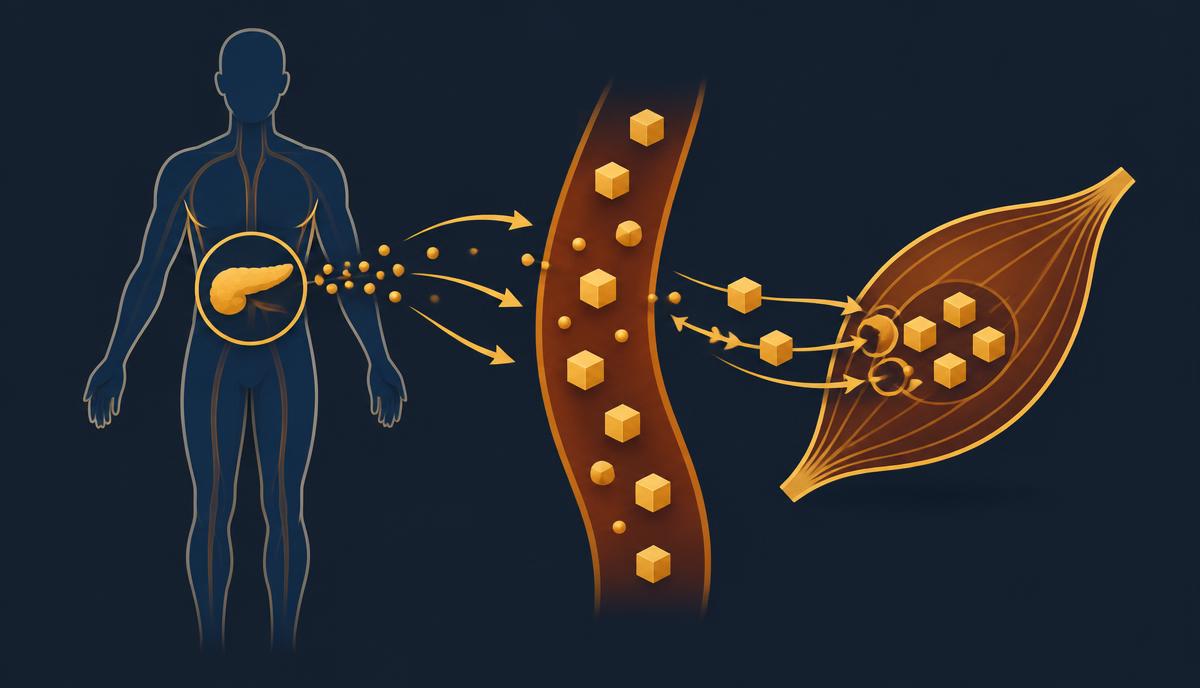
A clear explanation of how insulin and glucagon keep blood glucose within a narrow range, what happens after meals and during fasting, how continuous glucose monitors read this system, and how it breaks down in diabetes.
How resistance training produces strength and size gains, why early progress is mostly neural, what drives muscle protein synthesis, and what the research says about training variables like volume, load and frequency.
An evidence-based look at how body water loss affects physical and cognitive performance, how sweat rate and electrolyte loss are measured, and why the widely repeated hydration numbers are less precise than they sound.
How concept maps represent relationships between ideas, why they differ from mind maps, what the evidence says about their effect on learning, and how to build one that reflects genuine understanding rather than decoration.
How different types and timing of feedback affect skill learning, why immediate feedback can sometimes hinder long-term retention, and what deliberate-practice research says about giving and using feedback well.