In short
Evaluating a source well means asking who made the claim, what evidence actually supports it, and how it holds up when checked against independent sources, rather than judging it by surface features like tone, design or apparent authority. Professional fact-checkers outperform trained academics at this not through more knowledge but through a specific habit called lateral reading. The process generalises across news, research papers, social media and everyday claims, though the checks differ in depth by context.
Most advice on evaluating sources focuses on surface features: does the site look professional, is there an 'About' page, is the writing free of typos. These cues correlate weakly at best with reliability, and are easy to fake. A well-known 2018 study by the Stanford History Education Group found that professional fact-checkers reliably outperformed history PhD students and undergraduates at judging unfamiliar websites — not because they knew more facts, but because they used a fundamentally different process.
The habit that separates fact-checkers from everyone else
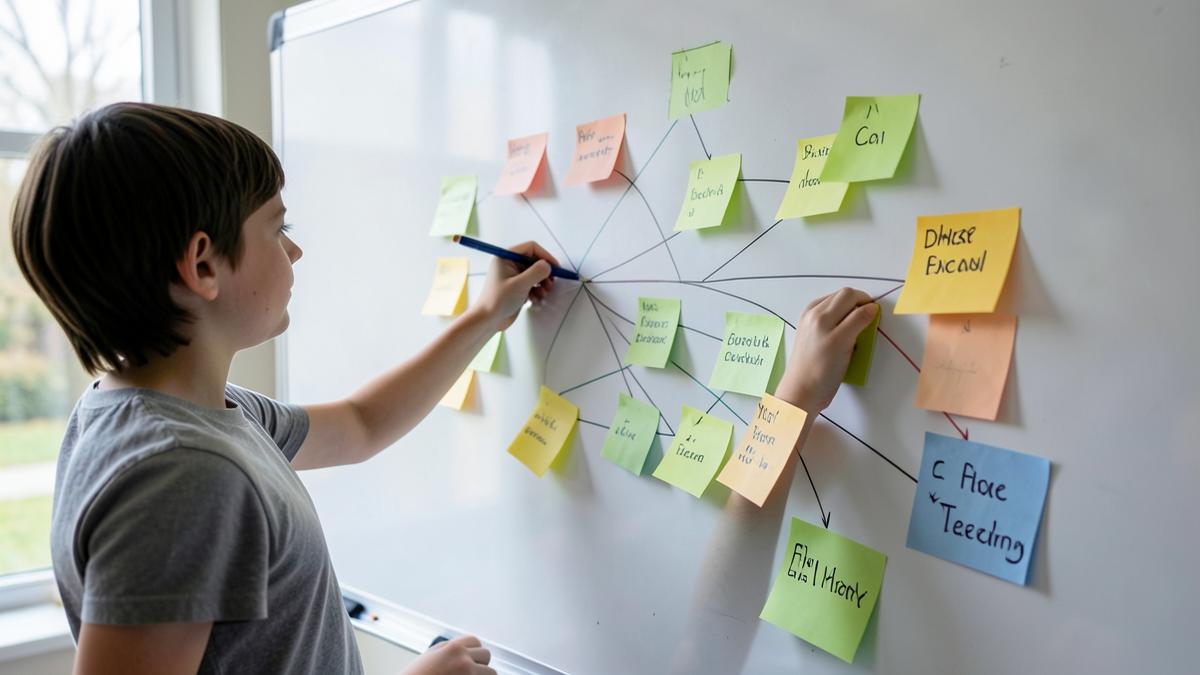
The fact-checkers in that study spent very little time reading the site itself before forming a judgement. Instead, they left the page almost immediately and opened several other tabs to find out who was behind it, what independent sources said about it, and whether its central claim appeared anywhere else. This is called lateral reading, in contrast to vertical reading, which stays on the page and evaluates it entirely by its own internal presentation — exactly the approach that leaves you dependent on cues the source itself controls.
A four-question process
The process below, adapted from information-literacy frameworks used in research and journalism training, reduces to four questions asked roughly in order. Each one can stop the process early if the answer is bad enough.
- Who is making this claim, and what is their basis for making it? Search the author or organisation's name independently, not on their own page, to find what others say about their record, funding and expertise.
- What is the primary evidence for the claim, and is it the actual original source or a secondhand summary of it? Trace the claim back as far as it will go; each retelling introduces distortion and drops caveats.
- Does independent, unaffiliated coverage or research corroborate the claim, contradict it, or simply not mention it? Absence of any independent corroboration for an extraordinary claim is itself informative.
- What would have to be true, or untrue, for this claim to be wrong, and has anyone checked that? A claim with no clear way to be disproven is harder to trust regardless of how confidently it is stated.
Signals worth weighting, and signals that are noise
| Signal | Weight it deserves | Why |
|---|---|---|
| Author's track record on the specific topic, verified independently | High | Directly predicts likelihood of accuracy and disclosed limitations |
| Whether the claim traces to a primary source you can inspect | High | Removes distortion introduced by intermediate retellings |
| Independent replication or corroboration | High | A single source, however careful, can still be wrong or unrepresentative |
| Professional visual design | Low | Cheap to produce and uncorrelated with accuracy |
| Number of citations or footnotes present | Low on its own | Only meaningful if the cited sources actually support the specific claim made |
| Confident or authoritative tone | Low, and can be negative | Overstated certainty is itself a caution sign in most research writing |
| Domain type (.edu, .org, .gov) | Low to moderate | Indicates institutional category, not the accuracy of a specific page hosted there |
Applying it to a research paper specifically
Academic papers need a slightly different checklist because their format hides different weaknesses than a news article does. Peer review filters some errors but does not verify replication, and a published result can still be a false positive, especially from a small or underpowered study.
- Check the sample size and study design before the conclusion — a striking finding from thirty participants deserves far less weight than the abstract's confident phrasing suggests.
- Check whether the result has been independently replicated, not merely cited; citation counts include papers that fail to replicate the original finding.
- Note funding sources and potential conflicts of interest, which are typically disclosed but easy to skip past.
- Distinguish correlational findings from causal claims — this distinction is frequently blurred in the abstract and headline coverage even when the paper's own body is careful.
- Prefer meta-analyses and systematic reviews over single studies when a general conclusion is needed, since they aggregate across the field's noise.
Where source evaluation errors tend to originate
Illustrative share of misjudged claims, by evaluator's stated reason for trusting the source
Illustrative distribution reflecting patterns discussed in information-literacy research on why people misplace trust in unreliable sources; not a single measured dataset.
Trade-offs of a rigorous process
Costs and benefits of thorough source evaluation
Pros
- Substantially reduces the rate of accepting false or exaggerated claims
- Transfers across contexts — news, research, social media, marketing — since the underlying questions are the same
- Builds a durable, checkable habit rather than reliance on memorised trusted-source lists that go stale
Cons
- Takes real time, which is not always available for every claim encountered in a day
- Cannot fully resolve genuinely contested or emerging questions where the evidence itself is thin
- Requires judgement about which claims are worth the full process versus a quick sanity check
In practice, most people calibrate effort to stakes. A claim in casual conversation might get a single lateral search. A claim that will inform a decision, an argument you will repeat, or something you plan to publish deserves the full four-question process, including tracing it to its primary source.
Why the source-evaluation problem got harder
Two developments have made the old shortcuts less reliable. First, publishing costs collapsed: producing a professional-looking article, complete with citations, a polished layout and an authoritative byline photo, now takes minutes rather than the institutional apparatus that once stood behind it. Second, the volume of content aimed specifically at search engines and social feeds, rather than at accurately informing a reader, has grown faster than most people's habits have adapted to it. Neither development changed what actually makes a claim true; both changed how cheaply a claim can be dressed up to look true.
Generative text tools add a further wrinkle, because fluent, confident, well-structured prose is now trivial to produce regardless of whether anyone checked the underlying facts. Fluency has never been a reliable proxy for accuracy, but it is an even weaker one now that fluency itself carries almost no production cost. The practical response is the same lateral-reading habit described above; it simply matters more than it used to, because the surface cues it was already right to distrust are now cheaper than ever to fake.
How to trace a claim back to its source
Tracing a claim is a specific skill worth separating from the general four-question process. Start with the sentence making the claim and ask what it cites, if anything. If it cites another article rather than original data, open that article and repeat the step. Each hop in this chain is an opportunity for a caveat to be dropped, a number to be rounded in a flattering direction, or a conditional finding to be restated as a general one. A claim that has passed through three or four retellings before reaching you should be treated with real caution even if each individual retelling seemed faithful, because small distortions compound.
- Search the exact figure or quote in quotation marks to find its earliest identifiable appearance online.
- Check the publication date of every link in the chain — a chain of citations pointing back to a single years-old claim is not independent corroboration, however many links it contains.
- When the trail ends at a press release, a conference abstract, or a preprint rather than a peer-reviewed paper, treat the claim as provisional regardless of how it is being reported elsewhere.
- If the trail cannot be completed at all — no original source is locatable — that absence is itself a strong reason for scepticism, not a neutral outcome.
Common failure patterns worth naming
A handful of recurring patterns account for a large share of misplaced trust, and naming them makes them easier to notice in the moment rather than only in hindsight.
| Pattern | What it looks like | Correction |
|---|---|---|
| Citation laundering | A claim is repeated across many outlets, creating an impression of independent confirmation | Trace every citation back; count how many distinct original sources actually exist |
| False balance | A fringe view is presented alongside a well-established one as though the evidence were evenly split | Weigh the volume and quality of evidence on each side, not merely the number of voices presented |
| Cherry-picked study | A single favourable study is cited while a larger or more rigorous body of evidence points elsewhere | Check whether a systematic review or meta-analysis exists and what it concludes |
| Motivated framing | A true number is reported using whichever unit or comparison makes it look most dramatic | Ask what the same fact would look like expressed a different, equally valid way |
Building the habit rather than relying on willpower
Lateral reading is easiest to abandon under time pressure, which is precisely when it matters most, since rushed judgements are the ones most likely to rely on surface cues. Treating the first lateral search as a fixed, near-automatic step — something done before forming any opinion at all, rather than a discretionary extra step taken only when something feels suspicious — removes the need to notice suspicion in real time, which research on persuasion consistently shows people are bad at doing under pressure or when a claim confirms something they already wanted to believe.
It is also worth being honest about the limits of any individual habit. Even careful, experienced evaluators are more likely to accept a poorly sourced claim when it aligns with their existing views, a pattern well documented in research on motivated reasoning. Lateral reading reduces this bias by forcing contact with outside sources, but it does not eliminate it, which is one more reason the four-question process above asks about disconfirming evidence explicitly rather than only asking whether support exists.
Key points
- Lateral reading — leaving the page to check independently — outperforms judging a source by its own internal presentation.
- Ask who made the claim, what the primary evidence is, whether it is independently corroborated, and how it could be shown wrong.
- Design, tone and citation counts are weak signals; verified track record and traceable primary evidence are strong ones.
- Research papers need checks specific to their format: sample size, replication status, funding, and correlation-versus-causation.
- Calibrate the depth of evaluation to the stakes of the claim rather than applying the same effort everywhere.
Sponsored video
AdvertisementChecking for a video ad…
Frequently asked questions
Sources
- Lateral Reading and the Nature of Expertise: Reading Less and Learning More When Evaluating Digital Information — Stanford History Education Group / Teachers College Record
- Civic Online Reasoning: A Curriculum and Assessment Framework — Stanford History Education Group
- Why We Should Teach Lateral Reading — American Educator
- Evaluating Information: The Cornerstone of Civic Online Reasoning — Stanford History Education Group
About the author
Michael Adeyemi — Senior Technology Writer
Michael writes Inquro's computing and web-infrastructure coverage. He worked for eight years as a platform engineer on high-traffic content systems before moving into full-time technical explanation, and he still prototypes every measurement described in his articles before publishing the numbers.
- Qualifications
- MSc, Distributed Systems — University of Manchester
- BEng, Computer Engineering — University of Lagos
- Experience
- Eight years as a platform engineer on high-traffic content delivery systems
- Four years writing standards-based technical documentation
- Subject areas:
- Web performance, Networking, Systems architecture
- Contact:
- michael@inquro.example
Reviewed for factual accuracy by Dr. Rina Halvorsen, Editor-in-Chief (PhD, Cognitive Science), on 27 May 2026.
Structure, claim strength and whether an explanation actually answers the question a reader arrived with.
Inquro articles are commissioned, sourced, reviewed and re-checked under a published editorial policy. Corrections are made in place and dated — write to editorial@inquro.example if you find an error.