In short
Radiocarbon dating works because a tiny, steadily replenished fraction of atmospheric carbon is radioactive and decays at a known, fixed rate once an organism stops exchanging carbon with its environment. Measuring how much carbon-14 remains in a sample reveals how long ago that exchange stopped, provided the result is corrected against a calibration curve built from independently dated material. The method is powerful for material up to roughly 50,000 years old but has known blind spots and cannot date inorganic material such as stone or metal directly.
Radiocarbon dating is often described as though it directly reads an age off a sample, but it actually measures a ratio and then converts that ratio into a date using a physical decay law and an independently constructed calibration curve. Understanding both steps is what separates informed use of the method from the common oversimplification.
Where carbon-14 comes from
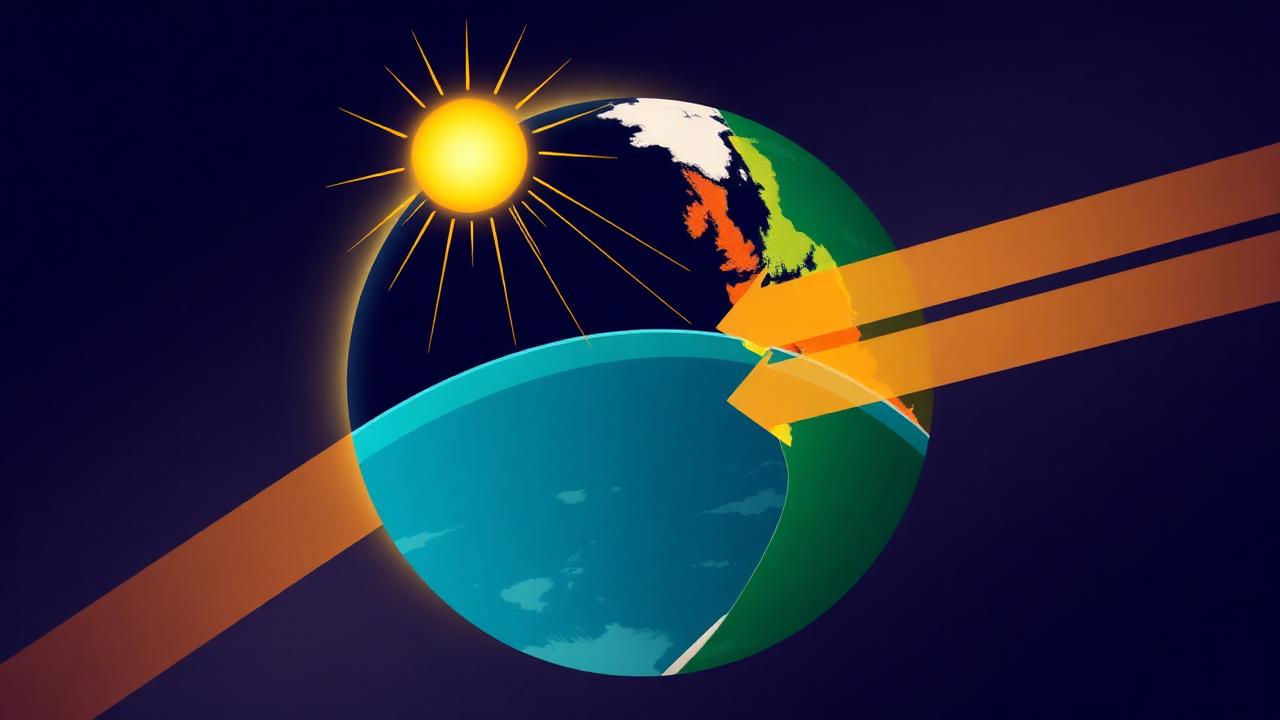
Cosmic rays striking the upper atmosphere produce neutrons that react with nitrogen-14 to form carbon-14, a radioactive isotope of carbon. This carbon-14 oxidises to carbon dioxide, mixes through the atmosphere, and is taken up by plants during photosynthesis in roughly the same fixed ratio to ordinary carbon-12 as exists in the air. Animals that eat plants, and animals that eat those animals, inherit the same ratio. While an organism is alive and exchanging carbon with its environment, its carbon-14 to carbon-12 ratio tracks the atmosphere closely.
The moment an organism dies, or otherwise stops exchanging carbon — a tree ring stops once formed, a shell stops once secreted — the carbon-14 already present begins to decay into nitrogen-14 without being replenished. The ratio of carbon-14 to carbon-12 in the remains therefore falls steadily and predictably from that point onward.
The decay law and the half-life
Carbon-14 decays with a half-life of about 5,730 years, meaning that after that period half of the original carbon-14 in a sample will have converted to nitrogen-14. This half-life is a fixed physical constant of the isotope and does not depend on temperature, pressure, chemical environment or anything else about the sample. Measuring the remaining fraction of carbon-14 and applying the known decay law gives, in principle, the time elapsed since the carbon stopped being replenished.
| Elapsed time | Approximate carbon-14 remaining |
|---|---|
| 0 years | 100% |
| 5,730 years (1 half-life) | 50% |
| 11,460 years (2 half-lives) | 25% |
| 17,190 years (3 half-lives) | 12.5% |
| 22,920 years (4 half-lives) | 6.25% |
| ~50,000 years | under 1%, near the practical detection limit |
Decay of carbon-14 with elapsed time
% of original carbon-14 remaining
Calculated directly from the accepted physical half-life of carbon-14 (5,730 years), not an empirical or illustrative estimate.
Why raw radiocarbon ages need calibration
A crucial complication is that atmospheric carbon-14 concentration has not been perfectly constant through history. It varies with solar activity, the strength of Earth's magnetic field, and, in recent centuries, human activity such as fossil fuel burning and above-ground nuclear testing. A raw radiocarbon measurement therefore gives a 'radiocarbon age' based on an assumed constant ratio, which must then be converted into a calendar age using a calibration curve.
That calibration curve is built by measuring the radiocarbon content of material whose calendar age is already known through an independent method, most importantly tree rings that can be counted and cross-matched year by year across overlapping living and dead specimens, extended further back using annually layered lake sediments, corals and cave formations. The internationally maintained curve, updated periodically as more independently dated material becomes available, currently extends usefully to around 55,000 years.
How the measurement is actually made
Early radiocarbon dating measured the rate of radioactive decay directly, counting the rare decay events from a large sample over an extended period — a slow method requiring substantial material. Modern laboratories almost universally use accelerator mass spectrometry, which counts the carbon-14 atoms themselves directly rather than waiting for them to decay. This is vastly more sensitive, needs a much smaller sample, milligrams rather than grams, and can process a sample in hours rather than days.
- The sample is chemically cleaned to remove contaminating carbon from soil, preservatives or handling.
- It is converted to a form suitable for the instrument, typically graphite or carbon dioxide gas.
- An accelerator mass spectrometer separates carbon isotopes by mass and directly counts carbon-14 atoms against carbon-12 and carbon-13.
- The measured ratio, corrected for natural isotopic fractionation, yields a raw radiocarbon age with a statistical uncertainty.
- The raw age is converted to a calendar-year range using the current internationally agreed calibration curve.
Where the method struggles
| Limitation | Why it happens | Practical consequence |
|---|---|---|
| Only works on organic material | Method relies on biological carbon uptake | Cannot date stone, metal or pottery fabric directly |
| Upper limit near 50,000 years | Carbon-14 fraction becomes too small to measure precisely | Older material needs other methods, e.g. potassium-argon dating |
| Contamination sensitivity | Even small amounts of younger or older carbon skew the ratio | Rigorous chemical pretreatment is essential |
| Marine reservoir effect | Ocean carbon exchange lags the atmosphere | Marine samples need a separate regional correction |
| Calibration curve wiggles | Atmospheric carbon-14 varied irregularly in the past | Some date ranges map to multiple possible calendar periods |
Radiocarbon dating as a scientific tool
Pros
- Directly grounded in a well-characterised physical decay law rather than a subjective scale.
- Independently cross-validated using tree-ring, ice-core and sediment chronologies.
- Requires only milligram-scale samples using modern accelerator mass spectrometry.
- Widely applicable across archaeology, geology, art authentication and climate science.
Cons
- Limited to organic material and to roughly the last 50,000 years.
- Vulnerable to contamination if pretreatment is inadequate.
- Calibration curve irregularities can produce wide or multiple possible calendar ranges for a single measurement.
- Marine and freshwater samples require additional regional corrections that carry their own uncertainty.
Isotopic fractionation and the delta-13C correction
Not all biological processes take up carbon-12 and carbon-13 in exactly the ratio present in the atmosphere; different photosynthetic pathways discriminate slightly against the heavier isotope, and this discrimination varies systematically between, for example, most trees and grasses and certain arid-adapted plants. Because carbon-14 is heavier still, it is affected proportionally more by the same discrimination process, which would introduce a small but real bias into the measured age if left uncorrected.
Laboratories correct for this by separately measuring the ratio of carbon-13 to carbon-12 in the sample, expressed as a delta-13C value, and using it to normalise the raw carbon-14 measurement to what it would have been for a standard reference material. This correction is applied routinely and automatically as part of the standard measurement process, and it is one of the reasons a competent radiocarbon laboratory, rather than a simplified calculation, is needed to produce a reliable date.
Sample selection: why some material dates better than others
Not every organic find is equally suited to radiocarbon dating, and the choice of material submitted for analysis materially affects the reliability of the resulting date. Short-lived material that formed over a narrow window, such as a single annual plant, a seed, or an individual tree ring, gives a tight and directly interpretable date. Long-lived material, most importantly old wood from the heartwood of a long-lived tree, can produce a date that is genuinely, correctly older than the archaeological event it is meant to represent, because the wood may have already been decades or centuries old by the time it was used — a systematic bias known as the old-wood effect.
| Material | Typical reliability | Main caveat |
|---|---|---|
| Annual seeds, short-lived plant remains | High | Minimal inherent age offset from the event dated |
| Individual tree rings, twigs, charcoal from small branches | High | Good where the growth year can be isolated |
| Old or structural timber, driftwood | Moderate to low | Can significantly pre-date the event through the old-wood effect |
| Bone collagen | Moderate to high | Requires good collagen preservation; degraded bone is unreliable |
| Marine shell | Moderate | Needs a regional marine reservoir correction |
| Groundwater-affected or heavily weathered material | Low | High contamination risk from exchange with the burial environment |
This is why archaeological reports increasingly specify not just that a sample was radiocarbon dated but exactly what material was submitted and how it was pretreated, since the interpretation of a date depends heavily on that detail. A short-lived seed found in a sealed context gives far stronger dating evidence for that context than a piece of old structural timber found nearby, even though both might return a radiocarbon measurement of similar apparent precision.
Key points
- Carbon-14 forms in the atmosphere, is taken up by living organisms, and decays at a fixed, known half-life of about 5,730 years after they die.
- A raw radiocarbon age must be converted into a calendar age using a calibration curve built from independently dated material such as tree rings.
- Modern dating uses accelerator mass spectrometry to count carbon-14 atoms directly, requiring only milligrams of sample.
- The method is reliable to roughly 50,000 years and only applies to material that once exchanged carbon with the atmosphere.
- Contamination control and regional reservoir corrections are essential to an accurate result.
Sponsored video
AdvertisementChecking for a video ad…
Frequently asked questions
Sources
- Radiocarbon dating overview — NOSAMS, Woods Hole Oceanographic Institution
- IntCal20: The Northern Hemisphere Radiocarbon Age Calibration Curve — Radiocarbon journal / IntCal Working Group
- Radiocarbon dating — USGS
- CODATA value: half-life of carbon-14 — National Nuclear Data Center, Brookhaven National Laboratory
- Radiocarbon dating: sample selection and pretreatment — Oxford Radiocarbon Accelerator Unit, University of Oxford
About the author
Dr. Luca Marchetti — Science Editor
Luca translates primary research into readable explanation. He reviews every science and health article for claim strength, checks that each figure traces back to a named dataset, and flags anywhere a study's finding has been stretched beyond what its method supports.
- Qualifications
- PhD, Environmental Physics — University of Bologna
- MSc, Physics — Sapienza University of Rome
- Experience
- Ten years of published research on atmospheric measurement records
- Six years as a reviewer for science communication projects
- Subject areas:
- Climate systems, Measurement, Scientific literacy
- Contact:
- luca@inquro.example
Reviewed for factual accuracy by Dr. Rina Halvorsen, Editor-in-Chief (PhD, Cognitive Science), on 14 May 2026.
Structure, claim strength and whether an explanation actually answers the question a reader arrived with.
Inquro articles are commissioned, sourced, reviewed and re-checked under a published editorial policy. Corrections are made in place and dated — write to editorial@inquro.example if you find an error.