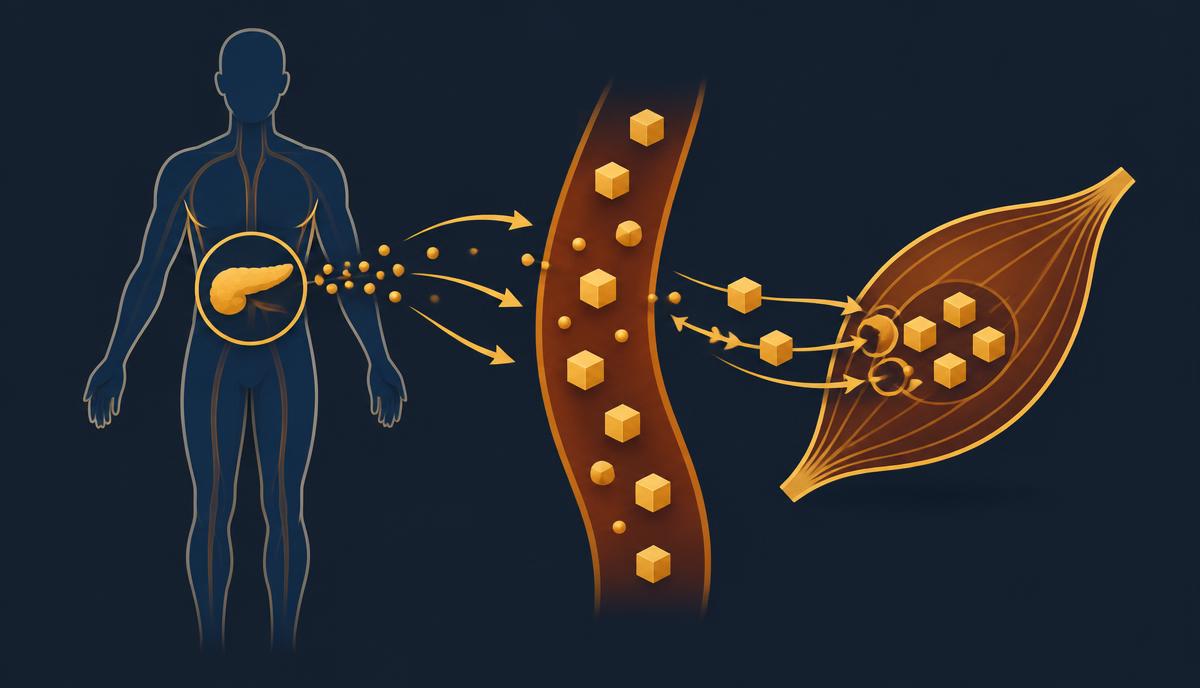
In short
Blood glucose is held within a narrow range by a feedback loop centred on insulin and glucagon from the pancreas, supported by the liver's ability to store and release glucose. Meals, fasting, exercise and stress all perturb the system, and its gradual failure underlies both type 1 and type 2 diabetes.
Blood glucose concentration is one of the most tightly regulated variables in human physiology. In a healthy adult it typically stays within a range of roughly 4.0 to 5.4 millimoles per litre (72 to 99 milligrams per decilitre) while fasting, despite meals delivering large, irregular boluses of sugar and despite muscles consuming it in bursts during exercise. This stability is not passive — it is maintained by an active hormonal feedback system.
The core feedback loop
The pancreas contains clusters of hormone-producing cells called the islets of Langerhans. Within them, beta cells release insulin when blood glucose rises, and alpha cells release glucagon when it falls. These two hormones act in opposition, forming a classic negative feedback loop: a rise triggers a hormone that lowers the level, and a fall triggers a hormone that raises it.
| Hormone | Released when | Main effects |
|---|---|---|
| Insulin | Blood glucose rises (e.g. after a meal) | Promotes glucose uptake into muscle and fat cells; signals the liver to store glucose as glycogen; suppresses the liver's own glucose production |
| Glucagon | Blood glucose falls (e.g. between meals, overnight) | Signals the liver to break down stored glycogen into glucose and release it into the bloodstream; stimulates new glucose production from non-carbohydrate sources |
The liver is the central storage and release organ in this system. It can hold roughly 100 grams of glucose as glycogen, enough to help buffer blood glucose for several hours of fasting. Muscle also stores glycogen, but in a form reserved for the muscle's own use rather than for releasing back into the bloodstream, because muscle cells lack the enzyme needed to export glucose.
What happens after a meal
Carbohydrate digestion breaks starches and sugars down into glucose, which is absorbed through the intestinal wall into the bloodstream. As blood glucose rises, beta cells detect it and secrete insulin within minutes. Insulin binds receptors on muscle and fat cells, prompting them to move glucose transporter proteins to the cell surface and pull glucose in from the blood. It simultaneously tells the liver to switch from producing glucose to storing it.
Typical blood glucose and insulin response after a mixed meal
relative level (fasting baseline = 1.0)
Illustrative pattern based on typical postprandial curves reported in metabolic research; exact timing and magnitude vary by meal composition and individual insulin sensitivity.
In most healthy people, blood glucose returns close to baseline within about two hours, even though insulin release itself is more prolonged and graded. The gut also releases incretin hormones, such as GLP-1, that amplify insulin secretion specifically in response to food intake, which is part of why an oral glucose load produces a larger insulin response than glucose delivered directly into a vein.
What happens during fasting and exercise
Between meals and overnight, falling glucose triggers rising glucagon and falling insulin. The liver responds by breaking down glycogen and, as fasting continues beyond roughly 12 to 24 hours, increasingly by manufacturing new glucose from amino acids and glycerol, a process called gluconeogenesis. Fat tissue also begins releasing fatty acids, which many tissues can use as fuel instead of glucose, sparing the limited glucose supply for tissues such as the brain that depend on it more heavily.
Exercise adds a further layer: contracting muscle can take up glucose through a pathway that operates partly independently of insulin, which is one reason regular physical activity improves overall glucose control even when insulin sensitivity is otherwise impaired. Stress hormones such as adrenaline and cortisol also raise blood glucose, part of a broader response that mobilises fuel during exertion or perceived threat.
- Adrenaline rapidly stimulates glycogen breakdown in the liver, useful for a fast fuel surge during acute stress or exercise.
- Cortisol acts more slowly and raises blood glucose over hours, partly by promoting gluconeogenesis and reducing tissue glucose uptake.
- Growth hormone reduces glucose uptake by tissues and contributes to the modest glucose rise seen overnight in some people, known as the dawn phenomenon.
- Because several hormones can raise glucose but only insulin substantially lowers it, insulin's role in the system is often described as uniquely central.
How continuous glucose monitors fit in
Continuous glucose monitors (CGMs) measure glucose in the interstitial fluid beneath the skin rather than directly in blood, using an enzymatic sensor that produces a small electrical current proportional to glucose concentration. Because interstitial glucose lags blood glucose by several minutes, CGM readings can differ from a same-moment fingerstick blood test, particularly when glucose is changing quickly, such as immediately after a meal or during exercise.
CGMs have made it far easier to observe the feedback loop described above in real time, and they are established tools in diabetes management. Their growing use by people without diabetes for general wellness tracking is more contested: professional bodies note that normal, harmless glucose fluctuation is common, and that interpreting CGM traces without clinical context can lead to unnecessary anxiety or unfounded dietary conclusions.
When the system breaks down
Diabetes arises from failure of this feedback loop, through two broadly different mechanisms. In type 1 diabetes, the immune system destroys insulin-producing beta cells, so insulin secretion falls towards zero and must be replaced externally. In type 2 diabetes, tissues become progressively less responsive to insulin's signal, a state called insulin resistance, and beta cells initially compensate by secreting more insulin before, in many cases, their output gradually declines as well.
| Feature | Type 1 diabetes | Type 2 diabetes |
|---|---|---|
| Underlying cause | Autoimmune destruction of insulin-producing beta cells | Progressive insulin resistance with variable beta-cell decline |
| Typical onset | Often childhood or early adulthood, can occur later | Usually adulthood, increasingly seen in younger people |
| Insulin levels | Absent or very low | Often initially normal or elevated, may fall over time |
| Primary treatment approach | Insulin replacement is always required | Lifestyle measures, oral medications, sometimes insulin |
In both conditions, the practical consequence is the same underlying problem: without effective insulin signalling, glucose accumulates in the blood instead of moving efficiently into tissues, and over years this persistently elevated glucose damages blood vessels and nerves, contributing to complications affecting the eyes, kidneys, nerves and cardiovascular system.
What to remember
- Insulin and glucagon form an opposing feedback loop that keeps blood glucose within a narrow range.
- The liver is the central buffer, storing glucose as glycogen and releasing it between meals.
- Multiple hormones can raise blood glucose, but insulin is the primary mechanism for lowering it.
- Exercise allows some glucose uptake independent of insulin, aiding overall glucose control.
- Type 1 diabetes involves loss of insulin production; type 2 involves resistance to insulin's effect.
- CGMs measure interstitial, not blood, glucose and lag true blood levels by several minutes.
Sponsored video
AdvertisementChecking for a video ad…
Frequently asked questions
Sources
- The Human Body: Diabetes — US National Institute of Diabetes and Digestive and Kidney Diseases (NIDDK)
- Glucose regulation and diabetes — UK National Health Service
- Physiology, Insulin — StatPearls, National Library of Medicine
- Global report on diabetes — World Health Organization
About the author
Jess Tran — Health & Wellbeing Writer
Jess writes Inquro's health literacy coverage with a strict rule: explain the evidence, never prescribe. Her articles are reviewed by the science desk and carry an explicit note wherever the underlying research is thin, contested or based on small samples.
- Qualifications
- MPH, Public Health — University of Melbourne
- BSc, Physiology — Monash University
- Experience
- Six years in population health programme evaluation
- Five years writing evidence summaries for non-specialist readers
- Subject areas:
- Public health, Sleep and circadian rhythm, Evidence appraisal
- Contact:
- jess@inquro.example
Reviewed for factual accuracy by Dr. Luca Marchetti, Science Editor (PhD, Environmental Physics), on 3 June 2026.
Traceability of every figure to a named dataset, correct handling of uncertainty, and whether a finding is being generalised beyond its study design.
Inquro articles are commissioned, sourced, reviewed and re-checked under a published editorial policy. Corrections are made in place and dated — write to editorial@inquro.example if you find an error.