In short
VO2 max quantifies the highest rate at which the body can take up and use oxygen during intense exercise, and it is regarded as one of the best single measures of cardiorespiratory fitness. Direct laboratory measurement uses respiratory gas analysis during a graded maximal exercise test, while consumer devices estimate it indirectly from heart rate and pace, with meaningfully less precision. Higher measured VO2 max is consistently associated with lower risk of several chronic disease outcomes, though association is not the same as a guarantee for any individual.
VO2 max is one of the most frequently cited numbers in both exercise science and consumer fitness devices, yet the two contexts measure it quite differently. Understanding what the number represents, and how much confidence to place in any given estimate, requires separating the physiological definition from the various ways it gets approximated.
What VO2 max quantifies
VO2 max is the maximum rate at which an individual's body can consume oxygen during progressively intense exercise, typically expressed relative to body weight, in millilitres of oxygen per kilogram per minute. It reflects the combined capacity of the lungs to take in oxygen, the heart and blood to transport it, and the muscles to extract and use it. Because it captures the ceiling of this whole delivery-and-use chain, it functions as a summary measure of cardiorespiratory fitness rather than a measure of any single organ.
Direct laboratory measurement
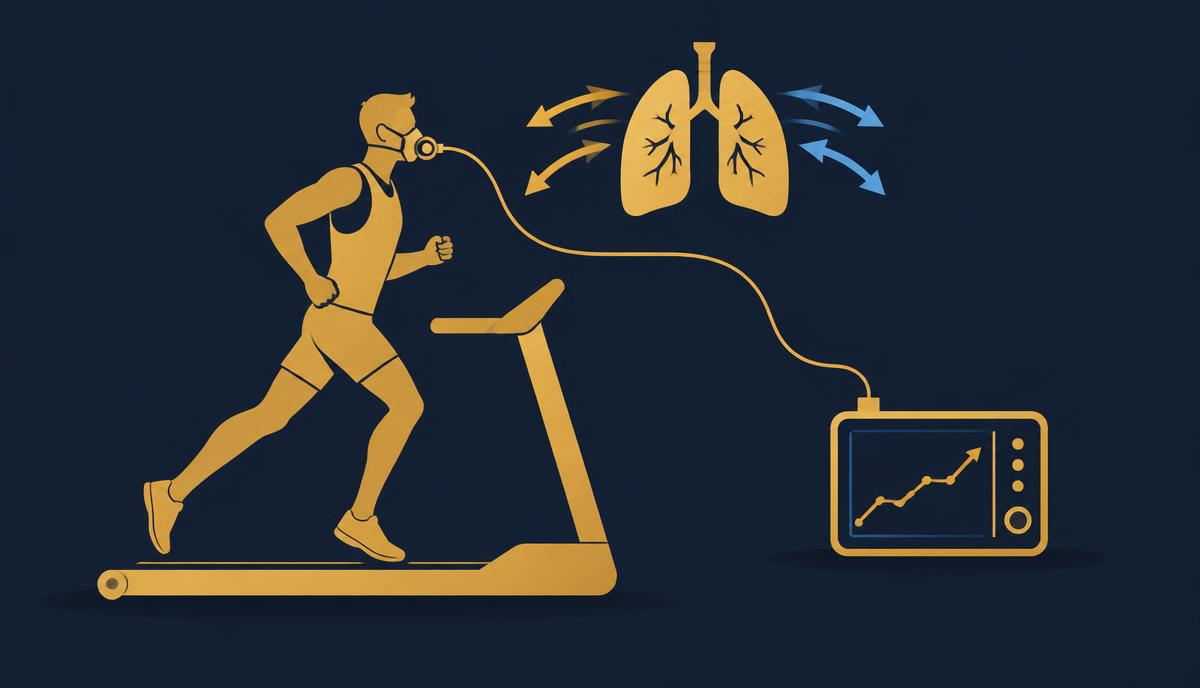
The reference-standard method uses a graded exercise test, usually on a treadmill or stationary bike, where workload increases at set intervals until the person reaches volitional exhaustion or meets defined stopping criteria. Throughout the test, a mask or mouthpiece captures the person's breath, and a metabolic cart measures the volume of air breathed along with the oxygen and carbon dioxide content of inhaled versus exhaled air, from which oxygen consumption is calculated directly.
| Criterion | What it indicates |
|---|---|
| Plateau in oxygen uptake despite increasing workload | Oxygen delivery/use system has hit its ceiling |
| Respiratory exchange ratio above about 1.10 | Heavy reliance on anaerobic metabolism, consistent with maximal effort |
| Heart rate near age-predicted maximum | Cardiovascular system near its own limit |
| Blood lactate substantially elevated post-test | Confirms very high exercise intensity was reached |
Because reaching a genuine plateau is not always achieved, researchers sometimes report 'VO2 peak' — the highest oxygen uptake observed during the test — as a more honest label when the strict plateau criterion is not met.
Estimating VO2 max without a lab
Since maximal gas-exchange testing requires specialised equipment and trained staff, several indirect methods have been developed. Sub-maximal protocols estimate VO2 max from the relationship between heart rate and workload during moderate exercise, extrapolated to predicted maximum heart rate. Field tests estimate it from performance, such as distance covered in a fixed time. Consumer wearables typically estimate it from a combination of heart rate during exercise, pace, and personal characteristics such as age and sex, using proprietary algorithms.
Approximate measurement error by method
typical error range (%)
Illustrative ranges drawn from validation literature comparing each method against directly measured laboratory VO2 max; error varies with protocol, population and device.
Wearable estimates can be useful for tracking an individual's own trend over months, since the same algorithm applied consistently may detect a genuine improvement even if the absolute number is imprecise. They are considerably less reliable for comparing between different people, or for treating a single reading as an exact physiological measurement.
Typical values and what they depend on
VO2 max varies with age, sex, training status and genetics, and it typically declines with age in adults who do not specifically train to maintain it. Trained endurance athletes commonly reach markedly higher values than the general population, reflecting both genetic contribution and years of adaptation from sustained aerobic training. Comparisons across sexes and ages generally require reference to population-specific norms rather than a single universal scale.
VO2 max and health outcomes
A substantial body of observational research links higher cardiorespiratory fitness, as measured or estimated by VO2 max, with lower rates of cardiovascular disease and lower all-cause mortality across large cohorts. Some of this research has led some professional bodies to describe cardiorespiratory fitness as a vital sign worth tracking alongside more traditional risk factors.
As with most fitness-and-health associations, most of the underlying evidence is observational, meaning fitter individuals may also differ in other health-relevant ways that are not fully captured by statistical adjustment. Interventional studies do show that structured aerobic training programmes can raise measured VO2 max over weeks to months, which is a more direct causal finding, though trials demonstrating that training-induced VO2 max increases translate into reduced long-term disease outcomes are harder to run and less numerous.
Relying on a wearable's VO2 max estimate
Pros
- Convenient and continuous, with no specialised equipment or appointment required
- Reasonably useful for tracking an individual's own trend over time using a consistent device and algorithm
- Encourages engagement with aerobic training, which has broader evidence of benefit regardless of the precision of any single reading
Cons
- Meaningfully less accurate than laboratory gas analysis, with error that varies by device and algorithm
- Less reliable for comparing fitness between different individuals or devices
- Algorithm changes between software updates can alter reported values without a real change in fitness
The physiology behind the ceiling
The Fick equation describes the relationship underlying VO2 max directly: oxygen consumption equals cardiac output multiplied by the difference between the oxygen content of arterial blood and the oxygen content of venous blood returning to the heart. Cardiac output — the volume of blood the heart pumps per minute — is itself the product of heart rate and stroke volume, the amount of blood ejected with each beat. At true maximal effort, heart rate is near its ceiling and stroke volume has typically plateaued earlier in the test, so cardiac output cannot rise much further, and this cardiovascular ceiling, more than lung capacity or muscle oxygen extraction, is usually the limiting factor in healthy trained individuals.
Muscle-level factors still matter, particularly the density of mitochondria and capillaries within trained muscle fibres, which determine how effectively the oxygen delivered can actually be extracted and used. This is one reason endurance training raises VO2 max even though it does not dramatically increase maximum heart rate, which is largely set by age and genetics and does not respond much to training: training instead raises stroke volume and improves the muscle's capacity to extract and use the oxygen that is delivered.
Running the test: what actually happens
A typical protocol begins with a low, comfortable workload and increases the treadmill speed or incline, or the cycling resistance, at fixed intervals of one to three minutes, continuing until the participant can no longer maintain the pace despite strong verbal encouragement, or until a supervising clinician stops the test for safety. Throughout, the mask captures every breath, heart rate is tracked continuously via ECG, and in many protocols a fingertip or earlobe blood sample is taken afterwards to measure lactate. The whole test, including warm-up and recovery monitoring, typically takes twenty to forty minutes, though the maximal portion itself usually lasts eight to fifteen minutes for a well-trained individual and less for an untrained one.
- Baseline resting measurements are taken to establish a reference point.
- Workload increases in fixed steps at fixed time intervals according to a chosen protocol, such as the Bruce protocol on a treadmill.
- Gas exchange, heart rate and perceived exertion are recorded continuously throughout.
- The test ends at volitional exhaustion or a defined clinical stopping point, whichever comes first.
- Recovery heart rate and, in some protocols, post-exercise lactate are recorded to help confirm maximal effort was reached.
Why protocol choice affects the number
The specific protocol used, the increment size, the modality (treadmill versus cycle ergometer), and even the equipment's calibration can all shift the reported VO2 max by a meaningful margin for the same person tested on different occasions. Treadmill tests typically produce slightly higher values than cycling tests for the same individual because running engages a larger total muscle mass, and protocols with larger workload increments can end the test earlier or later relative to true maximal effort. This is one reason comparing VO2 max figures across different studies, devices or gyms without knowing the underlying protocol is unreliable, and why serious research reports the specific protocol used alongside the result.
Interpreting a personal result
A single VO2 max number means little without context. Age- and sex-adjusted percentile tables, published by several exercise physiology bodies, translate a raw figure into a relative standing against a comparable population, which is generally more useful for an individual than the absolute number alone. Tracking change over repeated tests using the same method is more informative still, since it removes cross-sectional comparison problems and shows whether a specific training programme is producing a measurable physiological adaptation.
Key points
- VO2 max measures the ceiling of the body's oxygen delivery and use system during maximal exertion.
- Laboratory measurement uses direct respiratory gas analysis during a graded maximal exercise test.
- Sub-maximal protocols, field tests and wearables all estimate VO2 max indirectly, with progressively larger error.
- Higher cardiorespiratory fitness is consistently associated with better long-term health outcomes in observational research.
- Wearable estimates are best used to track personal trends rather than as precise absolute measurements.
Sponsored video
AdvertisementChecking for a video ad…
Frequently asked questions
Sources
- Importance of Assessing Cardiorespiratory Fitness in Clinical Practice — American Heart Association
- Physical Activity Guidelines for Americans, 2nd edition — US Department of Health and Human Services
- Exercise testing and cardiorespiratory fitness — PubMed / National Library of Medicine
- Physical activity — World Health Organization
About the author
Jess Tran — Health & Wellbeing Writer
Jess writes Inquro's health literacy coverage with a strict rule: explain the evidence, never prescribe. Her articles are reviewed by the science desk and carry an explicit note wherever the underlying research is thin, contested or based on small samples.
- Qualifications
- MPH, Public Health — University of Melbourne
- BSc, Physiology — Monash University
- Experience
- Six years in population health programme evaluation
- Five years writing evidence summaries for non-specialist readers
- Subject areas:
- Public health, Sleep and circadian rhythm, Evidence appraisal
- Contact:
- jess@inquro.example
Reviewed for factual accuracy by Dr. Luca Marchetti, Science Editor (PhD, Environmental Physics), on 1 March 2026.
Traceability of every figure to a named dataset, correct handling of uncertainty, and whether a finding is being generalised beyond its study design.
Inquro articles are commissioned, sourced, reviewed and re-checked under a published editorial policy. Corrections are made in place and dated — write to editorial@inquro.example if you find an error.