In short
Any model can be made to fit the data used to build it; the real test is whether it correctly predicts data it has never seen. Scientific validation is the deliberate process of checking a model's assumptions, its internal consistency, and above all its predictive skill against independent evidence, and of being explicit about the range of conditions over which it can be trusted.
A model, whether a simple equation, a weather simulation or a large computational climate model, is a simplified representation of reality built to make useful predictions. Building one that matches the data used to construct it is comparatively easy; almost any dataset can be fitted closely enough given a flexible enough model. The much harder and more important task is validation: establishing whether the model's predictions hold up against evidence it never saw during construction.
Verification and validation are different questions
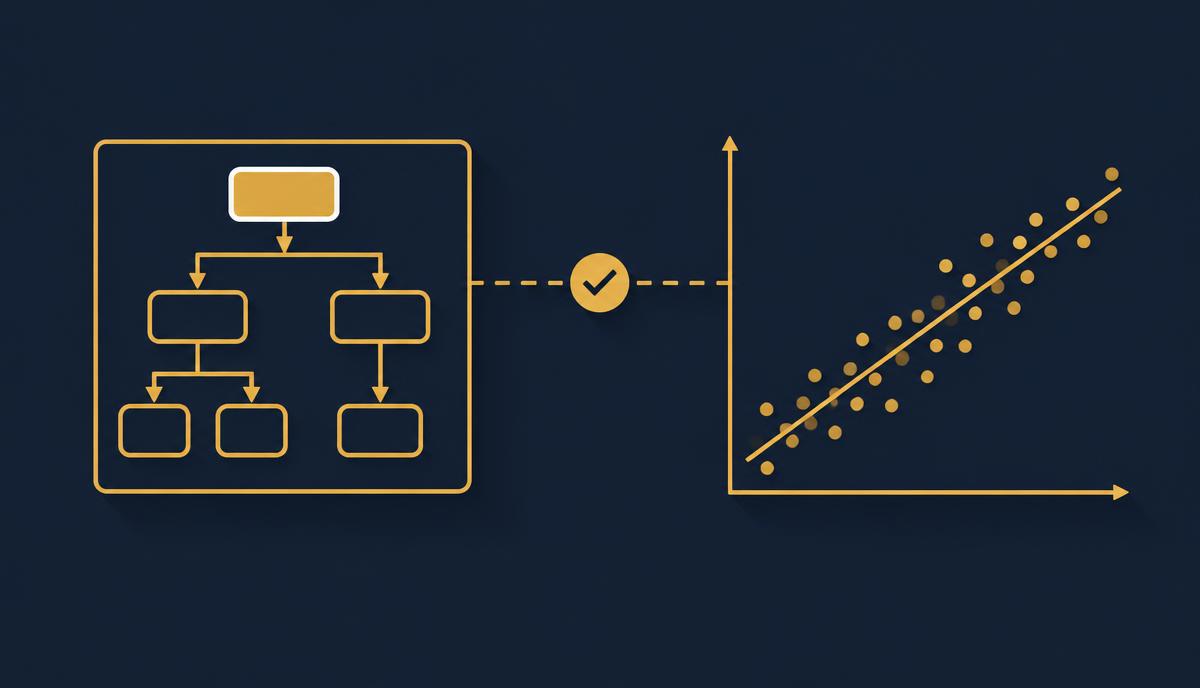
Model verification asks whether a model has been built correctly: does the code implement the intended equations without bugs, does the numerical method converge, does the software solve the mathematics it claims to solve. Model validation asks a separate question: does the model, correctly implemented, actually represent the real-world process well enough for its intended purpose. A perfectly verified model can still be badly validated if its underlying assumptions or physics are wrong, and a well-validated model can conceal verification bugs that happen to cancel out under the tested conditions.
| Question | Verification | Validation |
|---|---|---|
| What is being checked | Is the model solved correctly | Does the model represent reality |
| Typical method | Code review, convergence tests, known analytic solutions | Comparison against independent observations |
| Can pass while the other fails | Yes: correct code, wrong physics | Yes: right answer, buggy method (rare, but possible) |
| Owned by | Software and numerical methods team | Domain scientists with observational data |
The overfitting trap
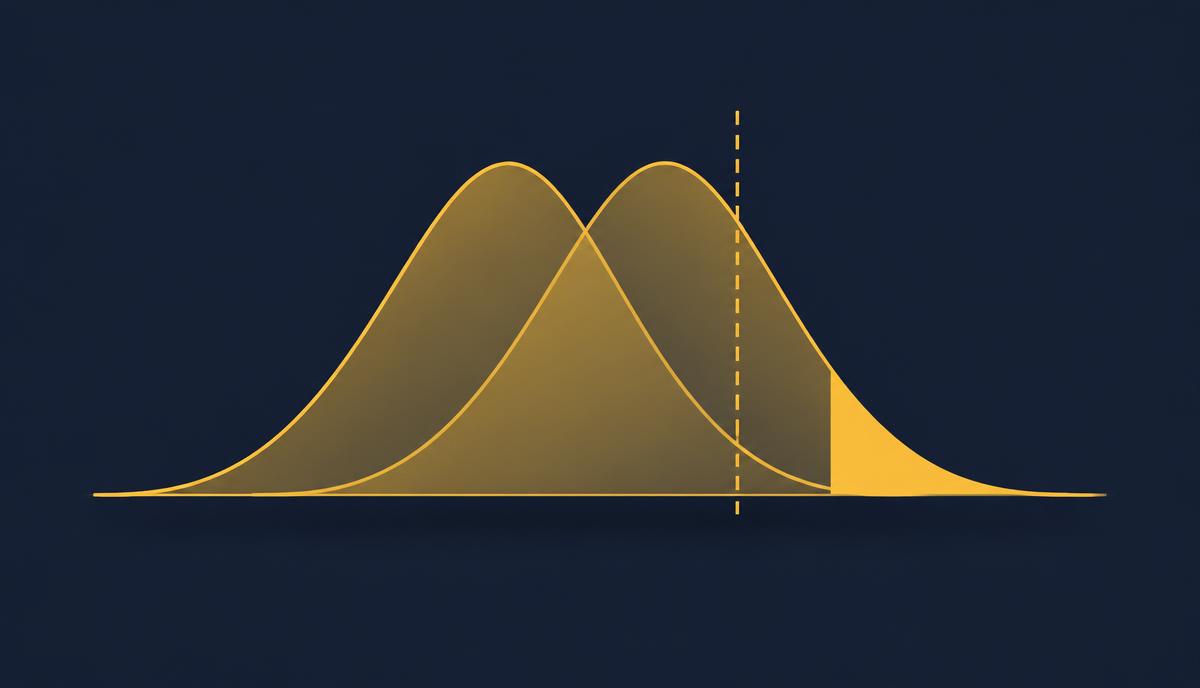
A model with enough free parameters can be tuned to pass through almost any set of training data with very small error, yet perform badly on new data. This is overfitting: the model has learned the noise and idiosyncrasies of the specific dataset rather than the underlying pattern that generalises. It is one of the most common ways a model appears impressive on paper and fails in practice, and guarding against it is a central concern of validation.
The standard defence is to hold back some data during model construction and test the finished model only against that untouched portion, an approach called out-of-sample testing or a held-out test set. A model's performance on the data used to build it, called in-sample fit, is not evidence of predictive skill; only its performance on data it never saw during fitting counts as a genuine test.
Hindcasting: testing predictions against the known past
For models of complex systems like climate or epidemics, waiting years for genuinely new future data to test a model would be impractical. Instead, scientists commonly use hindcasting: running the model as if it were making a forecast from an earlier starting point, using only the information that would have been available at that time, and comparing its output against what actually happened afterwards, which is already known. A climate model, for example, can be started using conditions from 1950 and run forward, with its simulated twentieth-century trends compared against the observed instrumental temperature record.
Independent replication and multiple lines of evidence
Confidence in a model grows fastest when independent groups, using different methods, different data or different model structures, arrive at consistent conclusions. In climate science, dozens of independently developed general circulation models built by different institutions worldwide are compared in coordinated exercises such as the Coupled Model Intercomparison Project, and confidence in projected outcomes is higher where models broadly agree and lower where they diverge. Consistency between an independent model and independent observational datasets, collected using different instruments and methods, is stronger evidence than agreement within a single dataset or a single model family.
- Agreement across independently built models, run by separate research groups, reduces the risk of a shared blind spot.
- Agreement between model predictions and independent observational datasets is stronger than internal consistency alone.
- Reproducing a known historical event the model was not tuned to reproduce is strong supporting evidence.
- Persistent, unexplained disagreement between a model and independent data is a signal that assumptions need revisiting, not that the data should simply be discarded.
Every model has a domain of validity
No model is valid for every possible condition, and a central part of responsible validation is stating clearly where a model's predictions can be trusted and where they cannot. Newtonian mechanics predicts planetary motion and everyday engineering problems extremely accurately, but breaks down at speeds approaching the speed of light, where relativistic effects dominate, and at atomic scales, where quantum effects dominate. This is not a flaw unique to Newtonian mechanics; it is a general feature of models, and identifying the boundary of validity is as important as the model itself.
Illustrative forecast skill versus lead time for a weather model
skill score (1.0 = perfect, 0 = no better than climatology)
Illustrative pattern typical of numerical weather prediction; actual skill scores vary by model, variable and region.
Quantifying uncertainty rather than hiding it
A validated model still carries uncertainty, arising from imperfect knowledge of initial conditions, unresolved processes represented only approximately, and the inherent unpredictability of some systems beyond certain timescales. Ensemble methods, running the same model many times with slightly varied starting conditions or slightly varied internal assumptions, are used to sample this uncertainty and express predictions as a range or probability distribution rather than a single number. A forecast presented as a single confident value, with no uncertainty range, has typically discarded information a well-validated model would actually provide.
Fit for purpose is a more useful standard than universally correct. A simplified model that ignores minor effects may be entirely adequate for one application, such as estimating a rough daily temperature range, while being unsuitable for another, such as predicting rainfall down to the hour in a specific valley. Validation should always be stated relative to a specific intended use, since a model validated for one purpose is not automatically validated for a different, more demanding one.
Key points
- Fitting available data well is a weak test; predicting independent data correctly is the real test of a model.
- Verification checks whether a model is solved correctly; validation checks whether it represents reality; both are needed.
- Hindcasting tests a model against the known past, but only counts if the tested period was not used to tune the model.
- Agreement across independently built models and independent observational data is the strongest form of validation evidence.
- Every model has a domain of validity, and a validated model is validated for a specific purpose, not universally.
Sponsored video
AdvertisementChecking for a video ad…
Frequently asked questions
Sources
- Guidelines for Verification, Validation and Uncertainty Quantification — National Institute of Standards and Technology
- Climate Change 2021: The Physical Science Basis, Chapter on Model Evaluation — Intergovernmental Panel on Climate Change (IPCC AR6 WG1)
- Coupled Model Intercomparison Project (CMIP) — World Climate Research Programme
- Deterministic Nonperiodic Flow — Journal of the Atmospheric Sciences (Edward Lorenz, 1963)
About the author
Dr. Luca Marchetti — Science Editor
Luca translates primary research into readable explanation. He reviews every science and health article for claim strength, checks that each figure traces back to a named dataset, and flags anywhere a study's finding has been stretched beyond what its method supports.
- Qualifications
- PhD, Environmental Physics — University of Bologna
- MSc, Physics — Sapienza University of Rome
- Experience
- Ten years of published research on atmospheric measurement records
- Six years as a reviewer for science communication projects
- Subject areas:
- Climate systems, Measurement, Scientific literacy
- Contact:
- luca@inquro.example
Reviewed for factual accuracy by Dr. Rina Halvorsen, Editor-in-Chief (PhD, Cognitive Science), on 5 March 2026.
Structure, claim strength and whether an explanation actually answers the question a reader arrived with.
Inquro articles are commissioned, sourced, reviewed and re-checked under a published editorial policy. Corrections are made in place and dated — write to editorial@inquro.example if you find an error.