In short
No single note-taking system is best overall; each imposes a different balance of capture speed, organisation and review effort, and each suits certain material better than others. Handwritten and typed notes also differ in a well-documented way, because typing enables verbatim transcription that skips the processing linked to better retention. Choosing a system is really choosing which cognitive work you do during the lecture or reading versus which you defer to later review.
Note-taking is usually taught as a formatting choice — bullet points versus paragraphs, one column versus two. The more useful way to compare systems is by what cognitive demand each one places on you while you take notes, since that demand is what determines whether notes are a byproduct of passive listening or an active part of learning in themselves.
Why the format changes what you learn
It is worth being precise about what 'notes' are for, because the same word covers two quite different jobs. One job is a record: something to consult later when memory fails, closer to an external filing system than a learning aid. The other job is a processing device: the act of taking the note is itself supposed to do some of the learning, so that even a note you never reread again has already left a trace. Most study advice conflates these, recommending a single format for both, when in practice the best record-keeping format and the best processing format are often not the same thing.
A frequently cited study by Mueller and Oppenheimer compared students taking notes by longhand against students typing on laptops during identical lectures. Laptop users took more notes and captured more words verbatim, but performed worse on conceptual questions tested afterwards, even when laptops were disconnected from the internet and used only for typing. The proposed explanation is that handwriting is slow enough to force paraphrasing and selection in real time, which is itself a form of processing, while typing permits transcription fast enough to bypass that processing almost entirely.
This finding does not mean typed notes are always worse — later replication attempts have produced mixed results depending on note-taking instructions given — but it does establish the underlying principle behind every system compared below: a system that forces selection, paraphrase or restructuring during capture tends to outperform one that permits pure transcription, independent of the tool used to write it.
The systems compared
None of the five systems below is a universal winner, and comparative studies of note-taking formats in isolation tend to find small or inconsistent effects, precisely because format is a weaker lever than the processing behaviour layered on top of it. The comparison is still useful, because each format nudges you toward a different amount and kind of processing by virtue of how it is structured, and picking one that fights against the material you are capturing makes the underlying behaviour harder to sustain.
| System | Structure | Processing required during capture | Best suited to |
|---|---|---|---|
| Cornell method | Page split into notes, cue column, and summary section | Moderate — cues and summary are written after, forcing review | Lectures and structured courses with a defined review routine |
| Outline method | Nested headings and sub-points by hierarchy | Moderate to high — requires judging structure while listening | Well-organised, linearly presented material |
| Mapping / concept mapping | Nodes and connecting lines showing relationships | High — requires identifying relationships in real time | Material with many cross-links rather than a strict hierarchy |
| Sentence method | Numbered, chronological sentences, one idea per line | Low during capture, none imposed structure to lean on | Fast-moving, unpredictable material where structure is unclear yet |
| Zettelkasten / linked notes | Atomic notes, each one idea, connected by explicit links | Very high, but mostly deferred to a separate processing pass | Long-term research and writing projects synthesising many sources |
Cornell notes in detail
The Cornell method, developed at Cornell University in the 1950s, divides the page into a wide note-taking column, a narrower cue column filled in afterwards with questions or keywords, and a summary strip at the bottom. Its main strength is that it builds retrieval practice directly into the format: covering the notes column and answering the cue-column questions from memory is a built-in self-test, not an extra step someone has to remember to add.
Concept mapping in detail
The outline and sentence methods in detail
The outline method nests points under headings by level of generality, which mirrors how well-structured lectures and textbooks are usually organised in the first place. Its advantage is that the structure itself is a form of processing: deciding whether a point belongs at the top level or as a sub-point under something else requires judging its relative importance while the material is still being delivered. Its failure mode is material that resists a clean hierarchy — a discussion that branches, backtracks, or presents competing views without resolving them into a tidy tree, at which point the note-taker either flattens the material inaccurately or falls behind trying to force it into nested bullets.
The sentence method, by contrast, imposes almost no structure at all: each new idea becomes a fresh numbered line in the order it was said. This makes it close to unbeatable for speed and for material where the structure is not yet clear — a fast-moving discussion, a first pass through an unfamiliar topic, an interview or meeting where interrupting the flow to reorganise notes would cost more than it saves. Its cost is deferred rather than avoided: because nothing is organised at capture time, a sentence-method page is nearly useless for review until a second pass imposes structure on it, which makes it a poor choice for anyone unlikely to do that second pass.
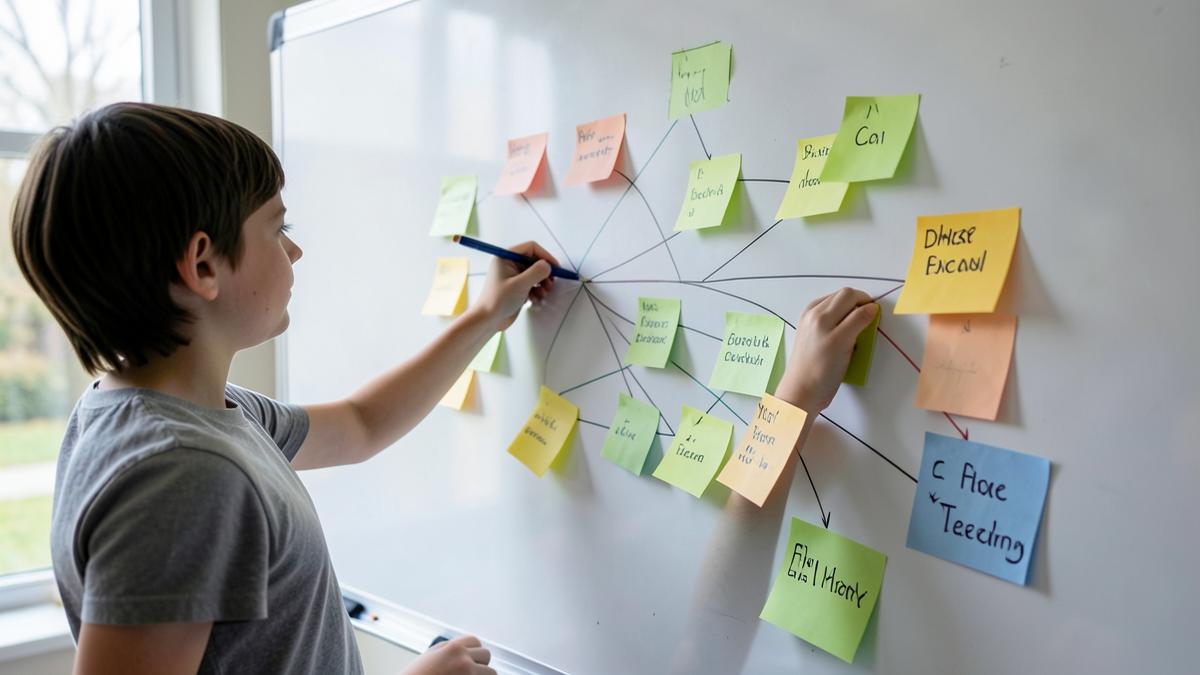
Mapping represents ideas as nodes and their relationships as labelled connecting lines, which suits material that is genuinely networked rather than strictly hierarchical — biological systems, historical causation, systems with feedback loops. Its cost is real-time demand: building an accurate map while new information is still arriving requires identifying relationships before you fully understand the material, which can cause students to fall behind live lectures. It works far better for reviewing and restructuring notes after the fact than for capturing a fast-moving talk live.
Zettelkasten and linked-note systems
Named after the German word for a card index, Zettelkasten-style systems (popularised for general audiences through descriptions of sociologist Niklas Luhmann's personal archive) store each idea as a short, self-contained note, explicitly linked to related notes rather than filed under a single hierarchical topic. The processing happens mostly after the initial capture: raw notes from a lecture or reading are later rewritten into atomic, permanent notes and deliberately linked to existing ones. This deferred, deliberate connection-building is well suited to work that synthesises many sources over months, and poorly suited to a single exam-focused course where the overhead of maintaining a linked archive outweighs the benefit.
A general capture-then-process method
Digital tools and the limits of format
Note-taking apps that support backlinks, tags and searchable archives make some systems easier to sustain — a Zettelkasten-style archive of a few hundred paper index cards is a real logistical burden that a linked digital notebook removes almost entirely. But the tool changes the cost of maintaining a system far more than it changes the underlying cognitive mechanism. A searchable digital archive full of transcribed, unprocessed notes is still a transcribed, unprocessed archive; it is merely easier to lose time inside. The choice of software is worth making deliberately, but it should follow the choice of processing habit, not substitute for it.
- During the lecture or reading, capture ideas in your own words rather than transcribing verbatim, even if this means capturing less overall.
- Leave visible gaps or flags next to anything unclear, rather than pausing to perfect it in the moment and losing the following content.
- Within 24 hours, review the raw notes and rewrite the key ideas into whichever structured format (Cornell, outline, map) suits that specific material.
- Generate two or three retrieval questions per section during this rewrite, to be answered from memory in a later review session.
- For material you expect to reuse across contexts, extract single atomic ideas into a linked permanent note rather than leaving them buried inside the original session's notes.
- Schedule a delayed review of the rewritten notes using retrieval rather than rereading, since the rewriting step alone does not guarantee retention without a later test.
Matching the system to the situation
Trade-offs across systems
Pros
- Cornell and outlining are fast to learn and require no extra tools, suiting most classroom and lecture settings
- Mapping surfaces relationships that linear formats hide, useful for genuinely networked subject matter
- Zettelkasten-style linking compounds over time, becoming more valuable the longer a research or writing project runs
- All systems benefit from the same underlying fix: forcing paraphrase during capture rather than transcription
Cons
- Structured systems (outline, map) impose real-time cognitive load that can cause a note-taker to fall behind fast-moving material
- Cornell's cue-and-review step is frequently skipped in practice, at which point it functions as an ordinary linear notes page
- Zettelkasten systems carry meaningful setup and maintenance overhead unsuited to short, single-purpose study
- No system compensates for notes taken from material that was not understood at the time; restructuring cannot manufacture comprehension
Illustrative retention by note-taking behaviour, not format
% recall on a test one week later
Illustrative pattern reflecting the general direction of findings distinguishing verbatim transcription from paraphrased, reviewed notes, drawing on the pattern reported by Mueller & Oppenheimer and related work; specific values vary by study.
Key points
- Processing depth during and after capture predicts retention better than which template or app is used.
- Verbatim transcription, easier with typing, tends to bypass the paraphrasing that drives learning during note-taking.
- Cornell notes build a retrieval step directly into the format; other systems require adding one deliberately.
- Mapping suits networked material; outlining and Cornell suit linear, hierarchical material; Zettelkasten suits long-running synthesis across sources.
- A short delayed rewrite-and-review pass improves any format more than switching formats does.
Sponsored video
AdvertisementChecking for a video ad…
Frequently asked questions
Sources
- The Pen Is Mightier Than the Keyboard: Advantages of Longhand Over Laptop Note Taking — Psychological Science, Mueller & Oppenheimer
- Cornell Note-Taking System — Cornell University Learning Strategies Center
- Note-Taking Habits of 21st Century Students and Impact on Academic Performance — Journal of Chemical Education
- Organizing Instruction and Study to Improve Student Learning — US Institute of Education Sciences Practice Guide
About the author
Jess Tran — Health & Wellbeing Writer
Jess writes Inquro's health literacy coverage with a strict rule: explain the evidence, never prescribe. Her articles are reviewed by the science desk and carry an explicit note wherever the underlying research is thin, contested or based on small samples.
- Qualifications
- MPH, Public Health — University of Melbourne
- BSc, Physiology — Monash University
- Experience
- Six years in population health programme evaluation
- Five years writing evidence summaries for non-specialist readers
- Subject areas:
- Public health, Sleep and circadian rhythm, Evidence appraisal
- Contact:
- jess@inquro.example
Reviewed for factual accuracy by Dr. Luca Marchetti, Science Editor (PhD, Environmental Physics), on 30 June 2026.
Traceability of every figure to a named dataset, correct handling of uncertainty, and whether a finding is being generalised beyond its study design.
Inquro articles are commissioned, sourced, reviewed and re-checked under a published editorial policy. Corrections are made in place and dated — write to editorial@inquro.example if you find an error.