In short
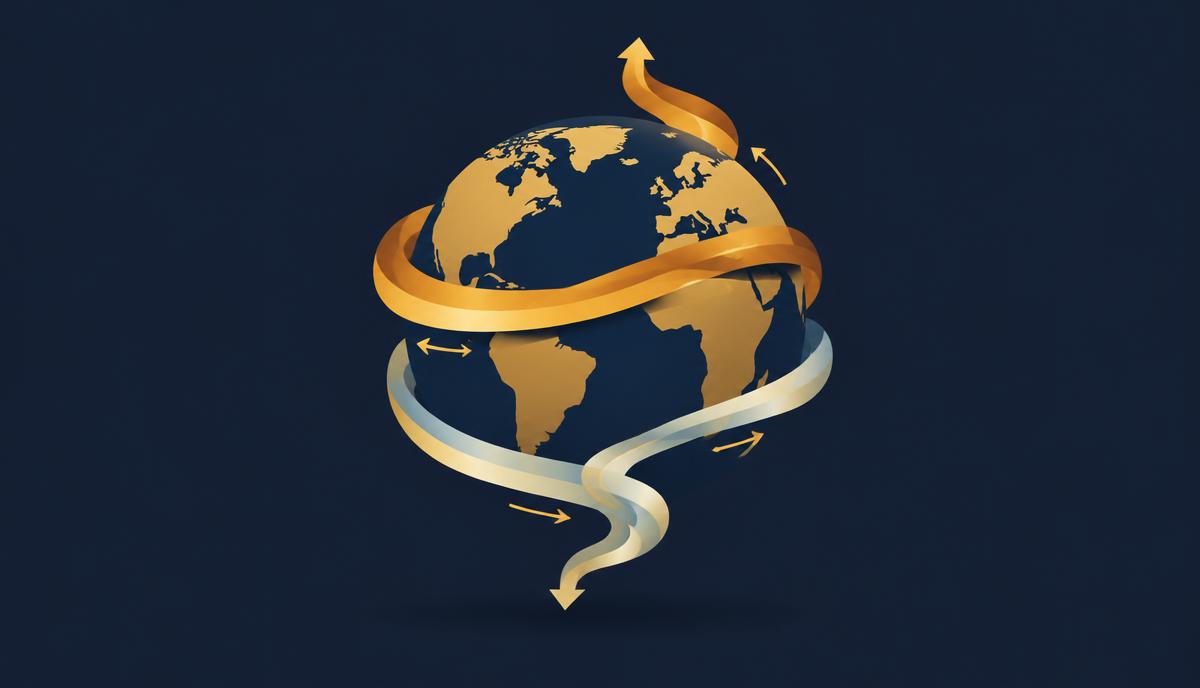
The ocean holds vastly more heat capacity than the atmosphere and moves it around the planet through a linked system of wind-driven surface currents and slower, density-driven deep circulation. This transport keeps Western Europe far milder than its latitude would otherwise suggest, and its long-term stability is one of the more closely monitored aspects of the climate system.
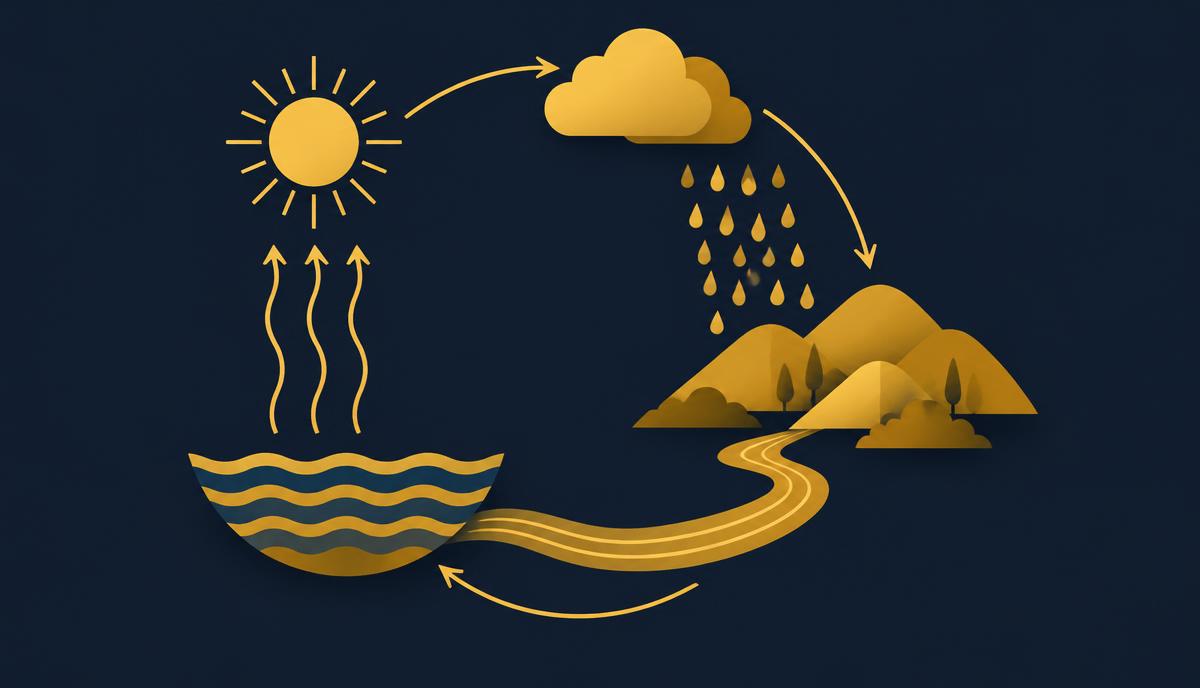
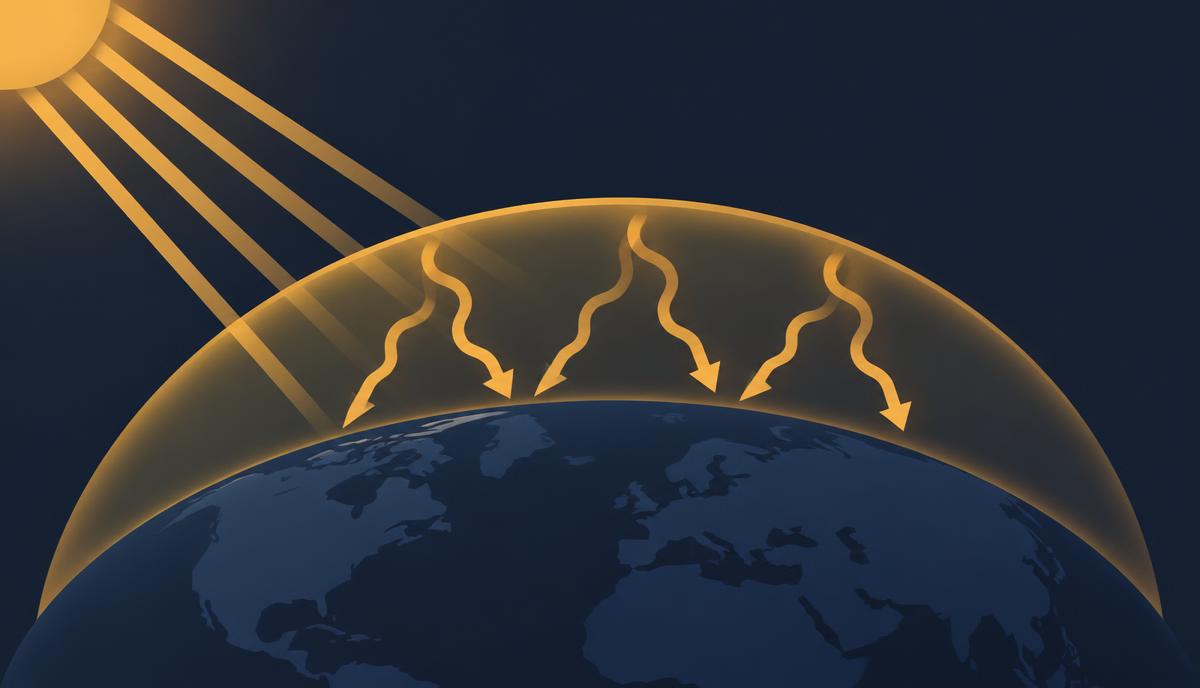
Water can absorb roughly four times as much heat as air for the same rise in temperature, and the ocean's mass dwarfs that of the atmosphere. As a result the ocean stores a far larger reservoir of heat than the air above it, and the currents that move that water around the planet are among the most powerful mechanisms redistributing heat from the tropics, where sunlight is most intense, towards the poles, where it is weakest.
Two circulation systems, working on different timescales
Ocean circulation operates through two overlapping systems. Wind-driven surface currents, powered by persistent global wind patterns and shaped by the Coriolis effect from Earth's rotation, move the upper few hundred metres of the ocean relatively quickly, forming large rotating gyres in each ocean basin. Thermohaline circulation, driven by differences in water density caused by temperature and salinity, moves water much more slowly through the deep ocean, forming a global-scale overturning pattern often called the global ocean conveyor belt.
| Feature | Wind-driven surface currents | Thermohaline circulation |
|---|---|---|
| Driving force | Persistent surface winds and Earth's rotation | Density differences from temperature and salinity |
| Depth affected | Upper few hundred metres | Full ocean depth, including the deep abyss |
| Typical speed | Up to several kilometres per hour | A few centimetres per second |
| Timescale for a full circuit | Weeks to years | Roughly 1,000 years globally |
| Example | Gulf Stream, Kuroshio Current | Atlantic Meridional Overturning Circulation |
The Gulf Stream and why Western Europe is milder than it should be
The Gulf Stream carries warm water northeastward from the Gulf of Mexico and the tropical Atlantic along the eastern coast of North America before crossing the Atlantic towards Europe, where it becomes the North Atlantic Current. This transport of warm surface water releases heat to the atmosphere as it travels, which is a major reason Western European winters are markedly milder than other regions at similar latitude, such as parts of eastern Canada, that do not benefit from comparable warm-water transport.
As this warm surface water travels north and releases heat to the cold Arctic air, it also becomes saltier through evaporation and colder, both of which increase its density. In the far North Atlantic, near Greenland and the Nordic seas, this cold, salty, dense water sinks to the deep ocean, a process called deep water formation. This sinking is the driving force behind the deep, slow return flow of thermohaline circulation, linking the surface Gulf Stream to a much larger, planet-spanning circulation system.
The Atlantic Meridional Overturning Circulation
The Atlantic Meridional Overturning Circulation, commonly abbreviated AMOC, describes this linked system: warm water flowing north near the surface, releasing heat, sinking in the North Atlantic, and returning south as cold deep water, eventually resurfacing elsewhere in the world's oceans through slow upwelling. AMOC moves an enormous quantity of heat, and its strength influences temperatures, rainfall patterns and sea level along the coasts bordering the Atlantic.
Illustrative depth profile of Atlantic overturning circulation strength
relative transport strength (illustrative, not to a single dataset scale)
Simplified illustration of how AMOC transport is distributed by depth; actual profiles vary with latitude and season and are derived from sustained observational arrays such as RAPID.
Is AMOC weakening, and why does it matter
Sustained observational arrays, such as the RAPID array across the Atlantic at roughly 26 degrees north, have directly measured AMOC strength continuously since 2004, and paleoclimate proxy studies suggest the circulation has weakened over the twentieth century compared with earlier centuries, though the exact magnitude and cause of the long-term trend remain an active area of research. The IPCC's Sixth Assessment Report concluded it is very likely that AMOC will weaken further over the twenty-first century as the planet warms, though it assessed an abrupt collapse within this century as unlikely, while noting it cannot be ruled out and would have high-impact, largely irreversible consequences on timescales of decades.
A weakening mechanism is well understood in principle: as the climate warms, increased rainfall and meltwater from Greenland's ice sheet add fresh water to the North Atlantic surface, making it less salty and less dense, and reducing its tendency to sink. Since that sinking is what drives the deep return flow, a persistent freshening could slow the entire circulation. Because AMOC redistributes so much heat, model projections generally suggest a substantially weakened AMOC would cool parts of the North Atlantic region and Western Europe even as the planet as a whole continues warming, alongside shifts in tropical rainfall belts and further sea level rise along the North American east coast.
Other major currents and their regional roles
The Atlantic is not the only ocean where currents shape regional climate. The Kuroshio Current plays a broadly similar warming role for Japan and the western Pacific coast that the Gulf Stream plays for Western Europe. The Antarctic Circumpolar Current, the largest current by volume transported, flows unimpeded around Antarctica and helps isolate the Southern Ocean thermally, contributing to Antarctica's extreme cold. El Niño and La Niña, driven by shifts in Pacific surface currents and winds, redistribute heat and rainfall on interannual timescales, affecting weather patterns worldwide.
- Gulf Stream / North Atlantic Current: warms Western Europe well beyond its latitude-predicted temperature.
- Kuroshio Current: plays an analogous warming role for East Asia's Pacific coast.
- Antarctic Circumpolar Current: isolates Antarctica thermally, reinforcing its extreme cold.
- El Niño-Southern Oscillation: shifts Pacific heat distribution, altering rainfall and temperature patterns globally for months to years at a time.
Why ocean heat transport matters for the whole energy budget
More than 90% of the extra heat trapped by rising greenhouse gas concentrations since the industrial era has been absorbed by the ocean rather than remaining in the atmosphere, according to sustained measurements from the Argo network of thousands of autonomous ocean-profiling floats. This makes ocean circulation not just a regional climate modifier but a central actor in the planet's overall energy balance, since how efficiently the ocean absorbs, stores and redistributes heat strongly influences how quickly surface air temperatures respond to continued greenhouse gas emissions.
Key points
- Ocean currents redistribute heat from the tropics towards the poles through both fast wind-driven and slow density-driven circulation.
- The Gulf Stream and North Atlantic Current keep Western Europe substantially milder than its latitude would otherwise suggest.
- Sinking of cold, salty water in the North Atlantic drives the deep return flow of thermohaline circulation.
- The IPCC assesses AMOC as very likely to weaken further this century, with an abrupt collapse considered unlikely but not ruled out.
- More than 90% of the extra heat trapped by rising greenhouse gases has been absorbed by the ocean, making ocean circulation central to the planet's energy balance.
Sponsored video
AdvertisementChecking for a video ad…
Frequently asked questions
Sources
- Climate Change 2021: The Physical Science Basis, Chapter 9 (Ocean, Cryosphere and Sea Level Change) — Intergovernmental Panel on Climate Change (IPCC AR6 WG1)
- What is the Gulf Stream? — National Oceanic and Atmospheric Administration
- RAPID: Monitoring the Atlantic Meridional Overturning Circulation — National Oceanography Centre (UK) / RAPID-AMOC Programme
- Argo: Global Ocean Observing Network — NOAA / Argo Program
About the author
Dr. Luca Marchetti — Science Editor
Luca translates primary research into readable explanation. He reviews every science and health article for claim strength, checks that each figure traces back to a named dataset, and flags anywhere a study's finding has been stretched beyond what its method supports.
- Qualifications
- PhD, Environmental Physics — University of Bologna
- MSc, Physics — Sapienza University of Rome
- Experience
- Ten years of published research on atmospheric measurement records
- Six years as a reviewer for science communication projects
- Subject areas:
- Climate systems, Measurement, Scientific literacy
- Contact:
- luca@inquro.example
Reviewed for factual accuracy by Dr. Rina Halvorsen, Editor-in-Chief (PhD, Cognitive Science), on 19 January 2026.
Structure, claim strength and whether an explanation actually answers the question a reader arrived with.
Inquro articles are commissioned, sourced, reviewed and re-checked under a published editorial policy. Corrections are made in place and dated — write to editorial@inquro.example if you find an error.