In short
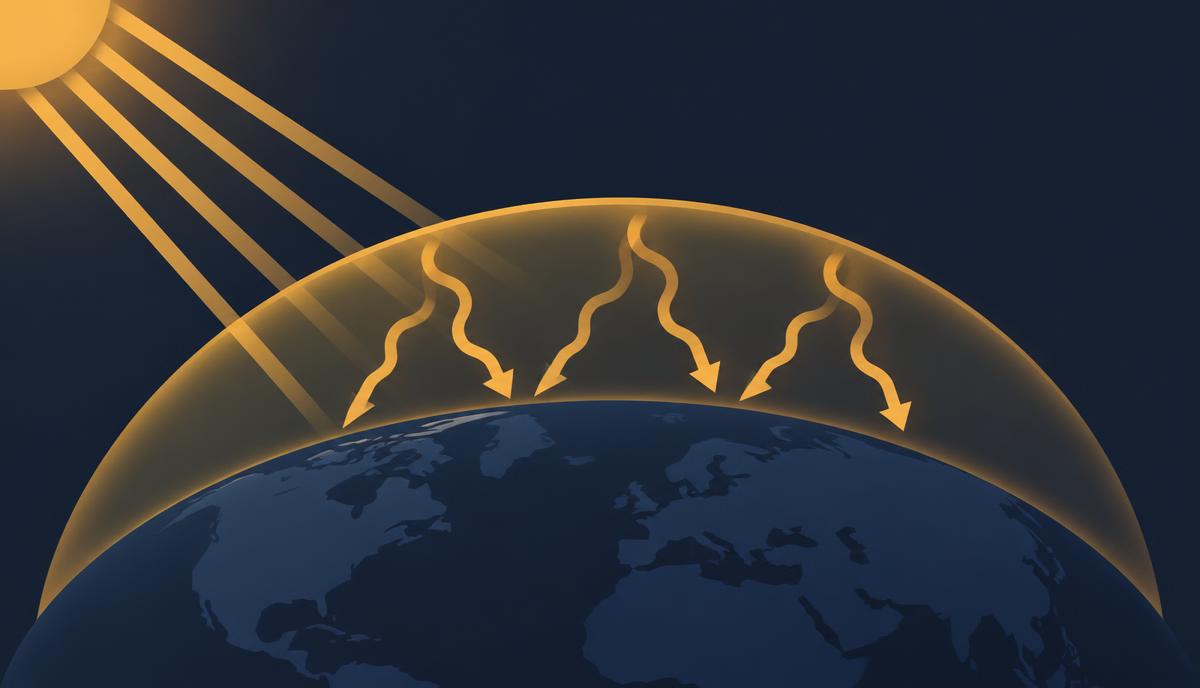
Water changing phase absorbs or releases far more energy than warming or cooling the same water by a few degrees, and this latent heat is quietly the largest single mechanism for moving energy through the atmosphere. Evaporation at the surface cools the ground and ocean while loading the air with hidden energy, which is released as heat wherever that vapour later condenses, often thousands of kilometres away.
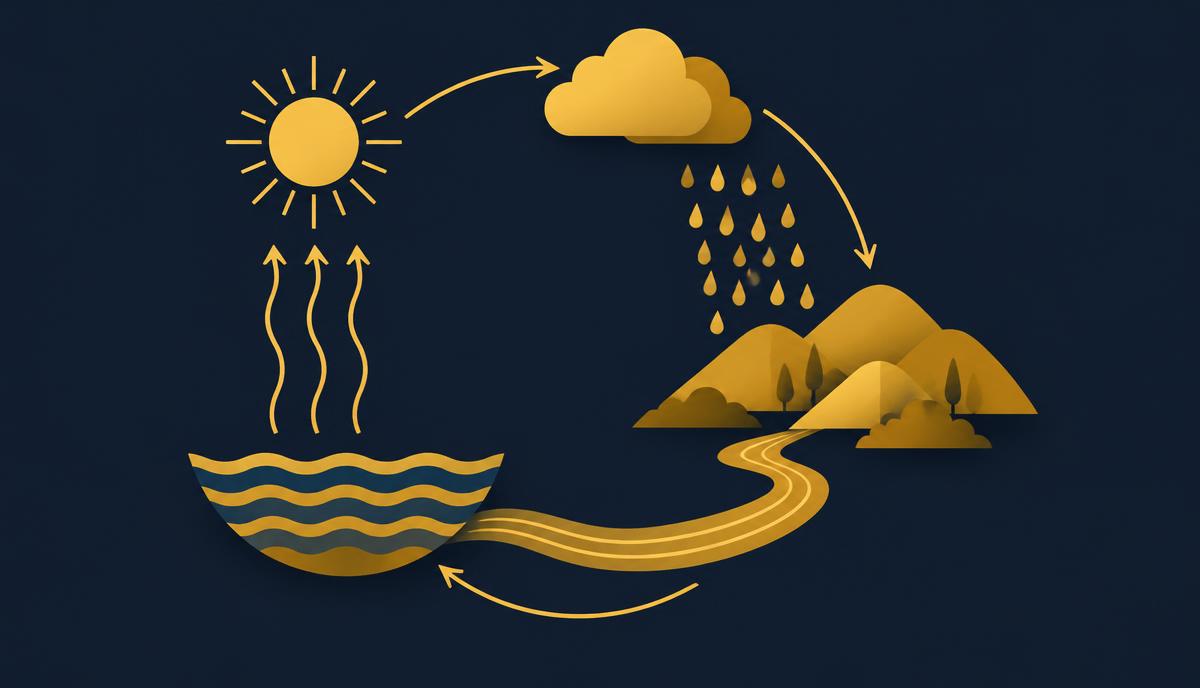
It takes far more energy to turn a gram of liquid water into vapour than to heat that same gram of water from freezing to boiling. This quantity, called latent heat of vaporisation, is the reason the water cycle functions as one of the planet's most powerful energy transport systems, not merely a mechanism for moving water from ocean to land and back.
Why phase change absorbs so much energy
Heating liquid water from 0 to 100 degrees Celsius requires about 419 joules per gram. Turning that same boiling water into steam, without raising its temperature any further, requires about 2,257 joules per gram — more than five times as much energy, all of it going into breaking the hydrogen bonds that hold water molecules together as a liquid rather than into raising temperature. At typical ambient temperatures, evaporating water absorbs roughly 2,450 joules per gram, a number that appears throughout meteorology and climate science as the latent heat of vaporisation.
| Process | Approximate energy | What happens to it |
|---|---|---|
| Warming 1g of water by 1°C | 4.2 joules | Raises temperature; released again on cooling |
| Melting 1g of ice at 0°C | 334 joules | Breaks crystal structure; no temperature change |
| Evaporating 1g of water at 20-25°C | ~2,450 joules | Breaks intermolecular bonds; carried away as vapour |
| Evaporating 1g of water at 100°C | 2,257 joules | Same bond-breaking, slightly less energy needed |
Evaporation is a cooling process at the surface
When water evaporates from the ocean, a lake or moist soil, it absorbs energy from its surroundings, cooling the surface it leaves behind. This is the same principle by which sweat cools skin. Over the oceans, which cover about 71% of Earth's surface, evaporation is the dominant way that surface heat is removed and exported into the atmosphere, more important globally than direct radiative loss or than warming the air by simple conduction and convection.
That evaporated water does not release its absorbed energy again until it condenses back into liquid, typically high in the atmosphere as clouds form. Because winds can carry water vapour a very long way before it condenses, the water cycle effectively transports heat energy from where evaporation happened to wherever condensation later occurs, sometimes thousands of kilometres away and days later.
Condensation is where the hidden energy reappears
Rising, cooling air eventually reaches a point where water vapour condenses into cloud droplets. At that moment, the roughly 2,450 joules per gram absorbed during evaporation is released back into the surrounding air as heat. This latent heat release warms the air parcel, making it more buoyant, which in turn drives it to rise further and cool further, causing more condensation and more heat release. This is the engine behind towering cumulonimbus clouds and the intense convection inside tropical storms.
A global energy transport system
Averaged across the planet, evaporation and the subsequent release of latent heat move roughly a quarter of the solar energy absorbed at Earth's surface into the atmosphere, a larger single term in the surface energy budget than the direct warming of air by contact with the ground. Because evaporation is concentrated over warm tropical oceans while condensation and its associated heat release are spread more broadly, including into higher latitudes carried by storm systems, the water cycle acts as one of the main mechanisms redistributing heat from the tropics towards the poles, alongside ocean currents and large-scale atmospheric circulation.
Global mean surface energy budget: how absorbed solar energy leaves the surface
watts per square metre (approximate global annual average)
Based on satellite and reanalysis-derived estimates of Earth's mean energy budget; values are long-term averages and vary regionally and seasonally.
Evapotranspiration: the water cycle over land
Over continents, plants contribute substantially to the movement of water and energy through transpiration, the process by which they draw water from soil through their roots and release it as vapour through pores in their leaves. Combined with direct evaporation from soil and surface water, this is termed evapotranspiration, and in vegetated regions it can account for a majority of the water leaving the land surface, alongside runoff into rivers.
- Forests typically evapotranspire more water than grasslands or bare soil, cooling local surface temperatures.
- Irrigated agriculture increases evapotranspiration, which can measurably cool nearby air relative to unirrigated land.
- Deforestation reduces evapotranspiration, which in some tropical regions reduces downwind rainfall by weakening this moisture recycling.
- Urban surfaces evapotranspire very little, contributing to the urban heat island effect through reduced evaporative cooling.
Why this matters for weather and climate forecasting
Latent heat release is one of the primary reasons weather forecasting is difficult in regions of active convection. Small errors in modelled humidity or temperature can change exactly where and how strongly condensation occurs, which changes how much latent heat is released, which changes the buoyancy and strength of the resulting storm — a feedback that compounds quickly and is a major source of forecast uncertainty in numerical weather prediction of thunderstorms and hurricanes.
In a warming climate, the atmosphere's capacity to hold water vapour increases roughly exponentially with temperature, a relationship known as the Clausius-Clapeyron relation, at approximately 7% more moisture per degree Celsius of warming. Because evaporation and condensation carry energy as well as water, a moister atmosphere is generally expected to produce more intense rainfall events even where total annual rainfall changes little, since more latent heat and moisture are available to be released in individual storms.
Distinguishing the water cycle's transport role from the greenhouse effect
It is worth being precise about what latent heat transport does and does not do. It moves existing energy from one place and time to another; it does not add new energy to the Earth system. The overall balance between incoming solar radiation and outgoing longwave radiation to space, which the greenhouse effect governs, sets the total energy available. The water cycle instead determines how that fixed total is redistributed, cooling ocean surfaces, powering storms, warming the upper troposphere and helping carry heat from the tropics towards the poles.
Key points
- Evaporating water absorbs about 2,450 joules per gram, far more energy than needed to simply warm the same water.
- That absorbed energy is released again, unchanged in amount, wherever and whenever the vapour condenses.
- Globally, latent heat transport removes more energy from the surface than direct heating of the air by contact.
- Condensation-driven buoyancy is the engine behind thunderstorms, and the fuel behind tropical cyclones.
- A warmer atmosphere holds more moisture, which tends to intensify rainfall events by increasing available latent heat.
Sponsored video
AdvertisementChecking for a video ad…
Frequently asked questions
Sources
- The Water Cycle — NASA Global Precipitation Measurement Mission
- Earth's Energy Budget — NASA Earth Observatory
- Climate Change 2021: The Physical Science Basis — Intergovernmental Panel on Climate Change (IPCC AR6 WG1)
- Understanding the Water Cycle — National Oceanic and Atmospheric Administration
About the author
Dr. Luca Marchetti — Science Editor
Luca translates primary research into readable explanation. He reviews every science and health article for claim strength, checks that each figure traces back to a named dataset, and flags anywhere a study's finding has been stretched beyond what its method supports.
- Qualifications
- PhD, Environmental Physics — University of Bologna
- MSc, Physics — Sapienza University of Rome
- Experience
- Ten years of published research on atmospheric measurement records
- Six years as a reviewer for science communication projects
- Subject areas:
- Climate systems, Measurement, Scientific literacy
- Contact:
- luca@inquro.example
Reviewed for factual accuracy by Dr. Rina Halvorsen, Editor-in-Chief (PhD, Cognitive Science), on 8 January 2026.
Structure, claim strength and whether an explanation actually answers the question a reader arrived with.
Inquro articles are commissioned, sourced, reviewed and re-checked under a published editorial policy. Corrections are made in place and dated — write to editorial@inquro.example if you find an error.