In short
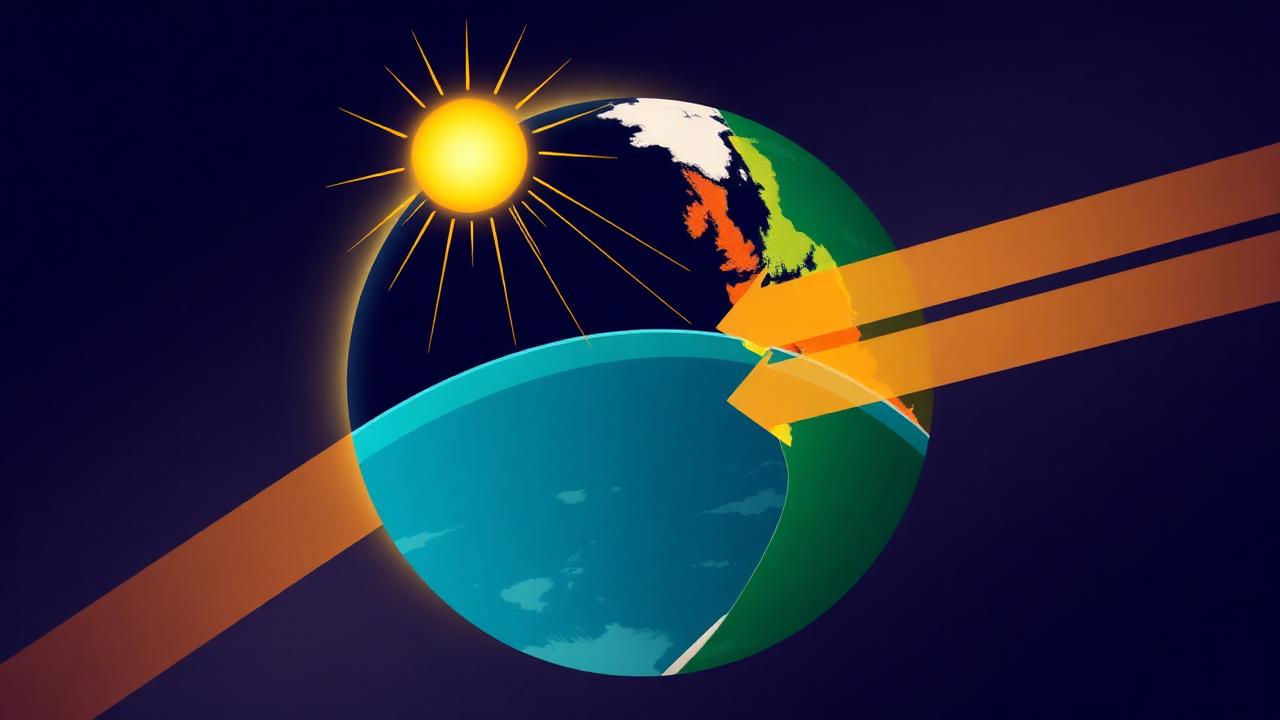
The greenhouse effect is a well-understood physical mechanism: certain gases in the atmosphere are transparent to incoming visible sunlight but absorb and re-emit outgoing infrared radiation, delaying its escape to space and warming the surface below. Without it, Earth's average surface temperature would sit far below freezing rather than its current habitable level. Adding more of those gases does not change the mechanism, only how strongly it operates, which is why rising concentrations produce additional warming.
The greenhouse effect is sometimes presented as a contested idea, but the underlying physical mechanism has been established since the nineteenth century and rests on well-measured properties of specific gas molecules. What is scientifically debated is not whether the effect exists, but precisely how sensitive the climate system is to a given increase in greenhouse gas concentration.
Why the name is slightly misleading
A garden greenhouse warms mainly by trapping heated air behind glass and preventing convective mixing with cooler surroundings — a mostly mechanical effect. The atmospheric greenhouse effect works through a genuinely different mechanism: selective absorption of specific wavelengths of radiation by particular gas molecules. The name stuck from early nineteenth-century analogy, but the physics is closer to a one-way filter than to a literal greenhouse.
The core mechanism, step by step
- The Sun emits radiation peaking in visible wavelengths, most of which passes through the atmosphere largely unabsorbed and reaches the surface.
- The surface absorbs that energy, warms, and re-radiates it as infrared radiation, at much longer wavelengths than sunlight because the surface is far cooler than the Sun.
- Certain atmospheric gases, mainly water vapour, carbon dioxide, methane and nitrous oxide, have molecular structures that absorb strongly at these infrared wavelengths, unlike the main atmospheric gases nitrogen and oxygen, which barely absorb them at all.
- A molecule that absorbs this infrared energy is excited and quickly re-emits infrared radiation in a random direction, including back toward the surface.
- This absorption-and-re-emission process repeats through many layers of the atmosphere, delaying the escape of infrared energy to space and keeping the lower atmosphere and surface warmer than they would be without those gases.
The reason nitrogen and oxygen, which together make up about 99% of the atmosphere by volume, play essentially no role in this process is molecular structure. Their two-atom, symmetric molecules do not have a way to absorb infrared radiation efficiently, because the vibrations that could absorb it do not change the molecule's charge distribution. Greenhouse gas molecules, with three or more atoms arranged asymmetrically, do have vibrational modes that interact strongly with infrared light.
| Gas | Approximate share of the enhanced greenhouse effect | Primary source of increase |
|---|---|---|
| Water vapour | Largest natural contributor, but responds to temperature rather than driving it directly | Amplifies warming caused by other gases (feedback) |
| Carbon dioxide | Largest human-driven contributor to current warming | Fossil fuel combustion, deforestation, cement production |
| Methane | Second-largest human-driven contributor, much shorter atmospheric lifetime | Agriculture, livestock, fossil fuel extraction, waste |
| Nitrous oxide | Smaller but long-lived contributor | Agricultural fertiliser use, industrial processes |
Why Earth needs some greenhouse effect
Without any greenhouse gases at all, calculations based on Earth's distance from the Sun and its reflectivity give an average surface temperature well below freezing, roughly minus 18 degrees Celsius, far colder than the observed global average of around 15 degrees Celsius. The roughly 33-degree difference between that calculated bare-rock temperature and the observed temperature is the natural greenhouse effect, and it is what keeps liquid water widespread on the surface.
Measuring the absorption directly
The infrared-absorbing property of carbon dioxide and other greenhouse gases is not inferred indirectly; it is measured in laboratory spectroscopy and directly observed from satellites, which record less infrared radiation escaping to space at exactly the wavelengths where carbon dioxide and methane absorb, with the missing radiation appearing more intense at other wavelengths where they do not. Ground-based instruments looking upward have separately recorded increasing downward infrared radiation at the surface at those same wavelengths, consistent with more of it being re-emitted downward as concentrations rise.
Atmospheric carbon dioxide concentration
Parts per million (ppm)
Approximate values consistent with the long-term Mauna Loa Observatory record maintained by NOAA and Scripps Institution of Oceanography; pre-industrial baseline is derived from ice-core records.
Feedbacks: what amplifies or dampens the effect
The direct warming from added carbon dioxide alone is a well-constrained physical calculation, but the total response of the climate system also depends on feedbacks that amplify or dampen it. Warmer air holds more water vapour, and since water vapour is itself a potent greenhouse gas, this amplifies the initial warming — a positive feedback. Melting ice reduces the surface's reflectivity, so more sunlight is absorbed rather than reflected, another positive feedback. Some processes act the other way; for instance, a warmer surface radiates more strongly, which is itself a stabilising, negative response that ultimately limits runaway warming.
| Feedback | Direction | Mechanism |
|---|---|---|
| Water vapour feedback | Amplifying | Warmer air holds more water vapour, itself a greenhouse gas |
| Ice-albedo feedback | Amplifying | Melting ice and snow reduce surface reflectivity, increasing absorbed sunlight |
| Planck response (basic radiative cooling) | Stabilising | A warmer surface emits more infrared radiation, resisting further temperature rise |
| Cloud feedback | Uncertain in sign and magnitude | Depends on cloud type, altitude and how cover changes with warming |
Common misunderstandings
- Carbon dioxide does not need to absorb all infrared wavelengths to matter; it absorbs strongly at specific wavelengths that are otherwise poorly covered by other gases.
- The effect is not 'saturated' in the sense of no longer mattering — adding more carbon dioxide continues to reduce the altitude from which infrared escapes to space, and that higher, colder emission altitude radiates less efficiently, which is what drives further warming.
- Water vapour being the largest natural greenhouse gas does not make carbon dioxide's role minor, because water vapour concentration is itself controlled by temperature and cannot accumulate independently the way carbon dioxide does.
- A cooler local day or a cold winter does not contradict a warming global trend, since the greenhouse effect changes the global energy balance over long timescales, not the outcome of any single local weather event.
How well-established the mechanism is
Pros
- The molecular absorption properties of greenhouse gases are directly measured in the laboratory, not inferred from climate models.
- Satellite and ground-based spectral measurements directly confirm the predicted absorption and re-emission pattern.
- The basic radiative mechanism has been quantitatively understood since the work of nineteenth and early twentieth-century physicists.
- Multiple independent lines of evidence — ice cores, direct atmospheric measurement, satellite spectroscopy — are mutually consistent.
Cons
- The exact magnitude of feedback-driven amplification, particularly from clouds, remains an active area of research with a meaningful uncertainty range.
- Regional and short-term outcomes are harder to predict precisely than the global long-term energy balance.
- Communicating a statistical, long-run mechanism to a public used to daily weather variability is a persistent challenge.
Key points
- Greenhouse gases are transparent to incoming sunlight but absorb and re-emit outgoing infrared radiation, delaying its escape to space.
- The natural greenhouse effect keeps Earth roughly 33 degrees Celsius warmer than a bare-rock calculation would suggest, and is essential for a habitable climate.
- The mechanism is confirmed by laboratory spectroscopy, satellite measurements, and ground-based infrared observations, not solely by climate models.
- Feedbacks, especially involving water vapour, ice cover and clouds, amplify or moderate the direct radiative effect and are the main source of remaining scientific uncertainty.
- Rising carbon dioxide concentration since the pre-industrial era is the dominant human-driven contributor to the recently enhanced effect.
How the mechanism was discovered
The physics behind the greenhouse effect was not derived recently; it developed over roughly a century of incremental work. Joseph Fourier, in the 1820s, first reasoned that Earth's atmosphere must retain heat in some way to explain why the planet was warmer than a bare calculation from solar distance alone would suggest, though he did not identify the specific mechanism. John Tyndall, in 1859, used laboratory experiments to show directly that water vapour and carbon dioxide absorb infrared radiation strongly while the main atmospheric gases, nitrogen and oxygen, barely absorb it at all, establishing the molecular basis of the effect. Svante Arrhenius, in 1896, went further still and calculated, using hand arithmetic, roughly how much global temperature would change if atmospheric carbon dioxide concentration were halved or doubled, arriving at a warming estimate for a doubling that remains broadly consistent with modern climate model ranges over a century later, an unusually durable result for an early calculation done without any of the tools of modern climate science.
Radiative forcing: putting a number on the effect
Climate scientists quantify the strength of the greenhouse effect and how much a given change disturbs it using radiative forcing, measured in watts per square metre, which represents the net change in energy balance at the top of the atmosphere caused by a specific factor. A doubling of atmospheric carbon dioxide concentration relative to pre-industrial levels is calculated to produce a radiative forcing of approximately 3.7 watts per square metre before accounting for feedbacks, a figure derived from line-by-line radiative transfer calculations validated against laboratory spectroscopy and satellite observation. This forcing framework allows different factors — carbon dioxide, methane, aerosols, changes in solar output, volcanic eruptions — to be compared on a common scale, and the sum of these forcings since the pre-industrial era, dominated by greenhouse gases and partly offset by cooling aerosols, is what current climate assessments attribute the observed warming to.
| Factor | Approximate forcing (watts per square metre) | Direction |
|---|---|---|
| Carbon dioxide | ~2.2 | Warming |
| Methane | ~0.5 | Warming |
| Nitrous oxide and halocarbons | ~0.3 combined | Warming |
| Aerosols and land-use changes | ~-0.9 (net, with wide uncertainty) | Cooling (partially offsetting) |
Comparing planets: Venus and Mars as natural test cases
Two nearby planets offer an instructive natural comparison, because they show what happens at very different greenhouse gas concentrations under otherwise roughly analogous solar heating. Venus has a dense atmosphere that is more than 96% carbon dioxide, and its surface temperature is around 465 degrees Celsius, hot enough to melt lead, far more than its distance from the Sun alone would predict — a runaway greenhouse effect widely attributed in planetary science to a thick, carbon-dioxide-dominated atmosphere combined with the past loss of surface water. Mars, by contrast, has an atmosphere that is also mostly carbon dioxide but extremely thin, roughly one percent the surface pressure of Earth's, and its average surface temperature is a frigid roughly minus 60 degrees Celsius, illustrating that the greenhouse effect's strength depends on the total quantity of absorbing gas present, not merely its chemical composition. Neither planet is a direct model for Earth's climate future, but both are used as real-world checks on the same radiative physics that underpins Earth's greenhouse effect.
Distinguishing weather variability from the underlying trend
A persistent source of public confusion is the difference between short-term weather variability, which is large and driven by many local factors, and the long-term energy-balance trend that the greenhouse effect describes. Any given day, season or even year can be colder than the recent average because of natural variability — ocean circulation patterns such as El Niño and La Niña, volcanic aerosols, or simple weather noise — without that observation saying anything meaningful about the multi-decade radiative trend. Climate scientists address this by looking at rolling multi-year and multi-decade averages specifically because they are designed to filter out the noise that obscures the signal in any single data point.
Sponsored video
AdvertisementChecking for a video ad…
Frequently asked questions
Sources
- The Causes of Climate Change — NASA Global Climate Change
- Global Monitoring Laboratory — Trends in Atmospheric Carbon Dioxide — NOAA
- AR6 Working Group I: The Physical Science Basis — Intergovernmental Panel on Climate Change
- Increases in greenhouse gas emissions and their attribution to observed radiative forcing — NOAA Annual Greenhouse Gas Index
About the author
Dr. Luca Marchetti — Science Editor
Luca translates primary research into readable explanation. He reviews every science and health article for claim strength, checks that each figure traces back to a named dataset, and flags anywhere a study's finding has been stretched beyond what its method supports.
- Qualifications
- PhD, Environmental Physics — University of Bologna
- MSc, Physics — Sapienza University of Rome
- Experience
- Ten years of published research on atmospheric measurement records
- Six years as a reviewer for science communication projects
- Subject areas:
- Climate systems, Measurement, Scientific literacy
- Contact:
- luca@inquro.example
Reviewed for factual accuracy by Dr. Rina Halvorsen, Editor-in-Chief (PhD, Cognitive Science), on 19 June 2026.
Structure, claim strength and whether an explanation actually answers the question a reader arrived with.
Inquro articles are commissioned, sourced, reviewed and re-checked under a published editorial policy. Corrections are made in place and dated — write to editorial@inquro.example if you find an error.